
New Biography Sheds Light on Iowa Writers’ Workshop Great Denis Johnson
 Flagrant, Self-Destructive Gestures by Ted Geltner, University of Iowa Press
 PHOTO: OLIVER MARK/WIKIMEDIA COMMONS
Late Iowa Writers' Workshop graduate Denis Johnson
PHOTO: OLIVER MARK/WIKIMEDIA COMMONS
Late Iowa Writers' Workshop graduate Denis Johnson
In Flagrant, Self-Destructive Gestures, the new biography of Denis Johnson (71BA, 74MFA), Valdosta State journalism professor Ted Geltner chronicles the troubled, brilliant life of one of the Iowa Writers’ Workshop’s most cherished and mythic graduates. Best known for his debut story collection, Jesus’ Son, relating the protagonist’s reckless, drug-and-alcohol-fueled misadventures, Johnson redefined the unreliable narrator, creating an endearing loser—a young man who is his own worst enemy, trying desperately to make peace with himself. That makes Johnson, who died in 2017, something of a moving target for the biographer, but here are three revelations from the book.
1.Geltner was surprised by the extent to which the stories in Jesus’ Son are autobiographical.
“I knew Jesus’ Son was based on real incidents, but I didn't realize how closely it was tied to him, that these were all actual people,” says Geltner. “He barely even changed their names. They’re not amalgam or composite characters.
“I was operating under the impression that John Dundon (from the story ‘Dundun’) had died shortly after Denis went out of his life. But then I found an obit and tracked down his wife. He died two weeks before I called.
“And then finding the actual crash that was the basis for Johnson’s seminal story, ‘Car Crash While Hitchhiking’. The couple who’d picked Denis up live in Northwood, Iowa. They live where they were driving that night 50 years ago. They were as shocked to meet me as I was to be able to find them.”
2.Johnson was not, as has long been assumed, a disciple of Raymond Carver.
They were friends who surely drank together at famous Iowa City literary watering holes like The Mill, but Johnson did not take Carver’s workshop, nor did he follow through when Carver introduced him to his editor, Gordon Lish.
“When Denis first started publishing novels, and people were writing things about him, they always said that he studied with Carver, because it was in the years that Carver was at his peak of his fame,” says Geltner. “[Carver] blurbed his first book. He introduced him to Lish, but it's overblown to say that he was his guy.”
3.Johnson was a prodigy in literature, arriving at Iowa as an undergrad who seemed fully formed and attracting the attention of Workshop founder Paul Engle.
Johnson published his first collection of poems when he was 19. As a graduate student, he fell under the tutelage of workshop professor Marvin Bell (63MFA), but before that, he was a protégé of workshop founder Paul Engle (32MA).
“There’s a connection, back to the birth of the writers’ workshop,” says Geltner. “He was super close with Engle. Engle got him jobs and took him to readings. They met when Denis was an undergrad. He’d discovered the beat poets, and he wanted to become a beatnik. Shortly thereafter, Engle started the International Writing Program, but he was a big part of Denis’ development.”
Johnson was born in 1949, part of the generation advised to “Tune in, turn on, and drop out.” And so he did. His characters are damaged, and they’re trying to undo the damage, or medicate the symptoms.
There is a moral lesson in Flagrant, Self-Destructive Gestures and studying the life of Johnson—not just that we should govern our worst instincts, but that although we may have walked a straighter, narrower path than Johnson did, our situation is no less precarious.
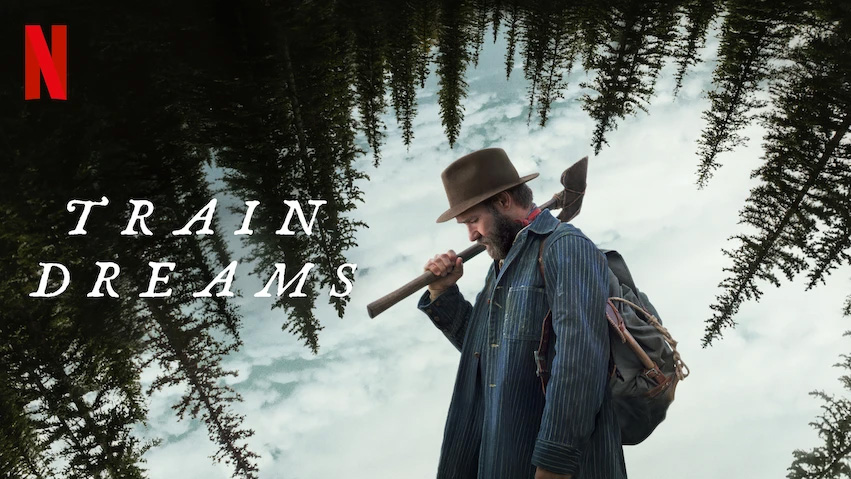 PHOTO COURTESY Netflix
Love and Loss
Train Dreams, an O. Henry Award-winning novella by the late Iowa Writers’ Workshop alum Denis Johnson (71BA, 74MFA), is now a critically acclaimed movie directed by Clint Bentley and starring Joel Edgerton and Felicity Jones. The film tells the story of Robert Grenier, from the time he arrives as an orphan on a train in Idaho at the beginning of the 20th century, through his career as an itinerant laborer on logging crews in the North Woods, to his life as a loving husband and father, to his death as a hermit in a cabin in the woods. Grenier is unlike Johnson’s antiheroes, not victimized by his own bad choices, but he suffers all the more, from an unfathomable tragedy that he survives but never reconciles.
PHOTO COURTESY Netflix
Love and Loss
Train Dreams, an O. Henry Award-winning novella by the late Iowa Writers’ Workshop alum Denis Johnson (71BA, 74MFA), is now a critically acclaimed movie directed by Clint Bentley and starring Joel Edgerton and Felicity Jones. The film tells the story of Robert Grenier, from the time he arrives as an orphan on a train in Idaho at the beginning of the 20th century, through his career as an itinerant laborer on logging crews in the North Woods, to his life as a loving husband and father, to his death as a hermit in a cabin in the woods. Grenier is unlike Johnson’s antiheroes, not victimized by his own bad choices, but he suffers all the more, from an unfathomable tragedy that he survives but never reconciles.