
Band of Birders: Tracking Hawks with the Iowa Raptor Project
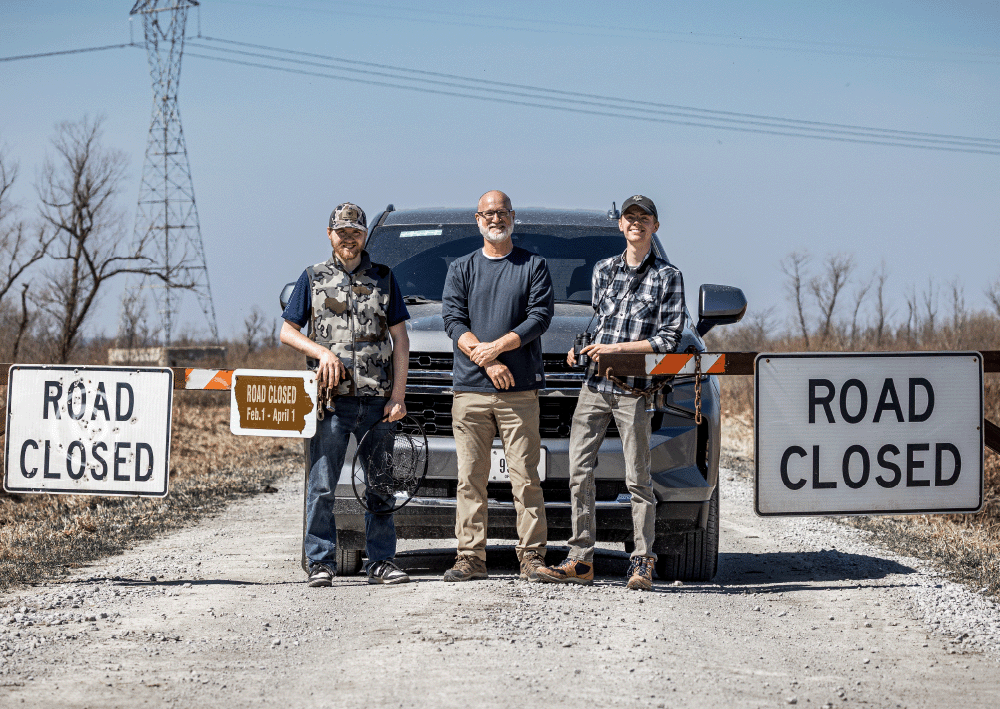 PHOTO: JOHN EMIGH
Iowa Raptor Project director Dave Conrads, center, is pictured with volunteers Aaron Petrie, left, and Caden Dorrance at the Hawkeye Wildlife Management Area in rural Johnson County.
PHOTO: JOHN EMIGH
Iowa Raptor Project director Dave Conrads, center, is pictured with volunteers Aaron Petrie, left, and Caden Dorrance at the Hawkeye Wildlife Management Area in rural Johnson County.
It’s a cloudless and chilly February morning when Iowa Raptor Project director Dave Conrads pulls up to the Levitt Center for University Advancement, home of Iowa Magazine. Photographer Seth Diehl (07BA), art director Nick Beecher (03BA), and I are heading out with Conrads’ team for a leg of their winter raptor survey—an annual count of the area’s birds of prey.
Before we pile into Conrads’ SUV, though, something catches our eye. A sizable bird swoops down, likely in pursuit of its unsuspecting meal. It lands near the office window I look out of every day, unaware of these natural dramas unfolding just beyond the glass. The bird has bluish-gray plumage, a hooked bill, and a beret-like cap. It’s instantly recognizable to our birding guides: a Cooper’s hawk, one of the many species of raptors commonly found in Iowa.
Our goal today is to locate and identify more of these regal hunters—and, if possible, catch and band one. Each winter, the Iowa Raptor Project—part of the University of Iowa College of Education’s UI WILD department—conducts surveys across Johnson County to study population trends and habitat needs for bald eagles, rough-legged hawks, northern harriers, and other birds of prey.
Spotting the Cooper’s hawk before we’ve even left campus is a good sign, we agree, but maybe not unexpected. Soon, we’ll see firsthand why Iowa is the home of the Hawks.
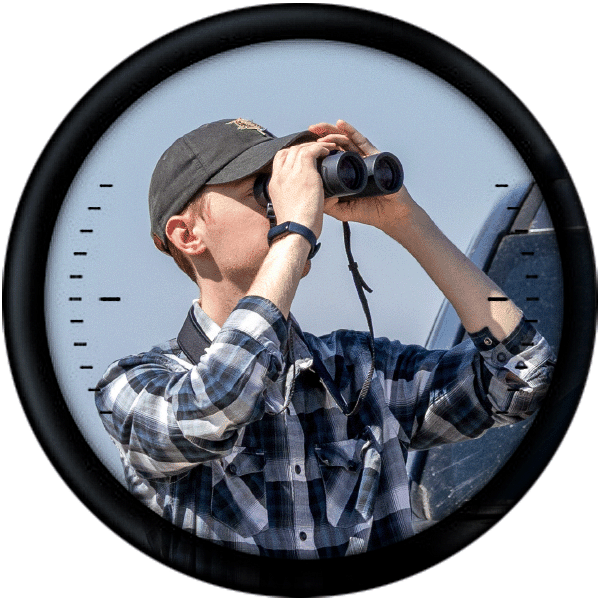
Winter is a favorable time to conduct bird population surveys, Conrads explains while navigating the Chevy Suburban down a gravel road. Not only are the trees bare, making it easier to spot the state’s year-round residents like Cooper’s hawks, but the cold months bring migratory birds from Canada, Alaska, and other far-flung locales.
Today’s expedition takes us to the Hawkeye Wildlife Management Area, a 15-minute drive northwest of campus and the site of one of three regular survey routes for the Iowa Raptor Project. This Department of Natural Resources-managed property is a peaceful mix of prairie, woodlands, and wetlands. It’s also a hotbed for birdlife—even if things seem lifeless to an untrained eye like mine on this sunny, 16-degree morning.
Shortly after 9 a.m., Conrads stops the vehicle and grabs his binoculars. His survey sidekicks—Iowa Raptor Project volunteers Aaron Petrie and Caden Dorrance—do the same. Petrie is a 2024 graduate of the UI REACH program, while Dorrance is an undergraduate studying Earth and environmental sciences. Both are passionate birders and Iowa Raptor Project volunteers who can tell you the difference between a sharp-shinned hawk and rough-legged hawk.
SOME OF IOWA'S RAPTORS
Tap the birds to learn more!
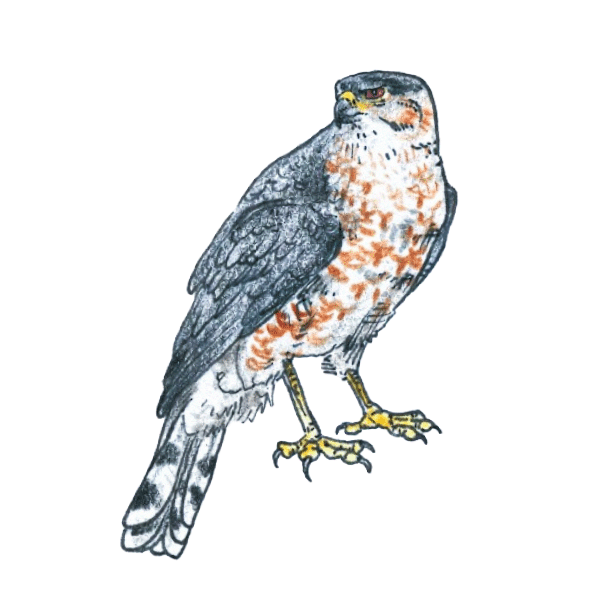 Cooper's Hawk
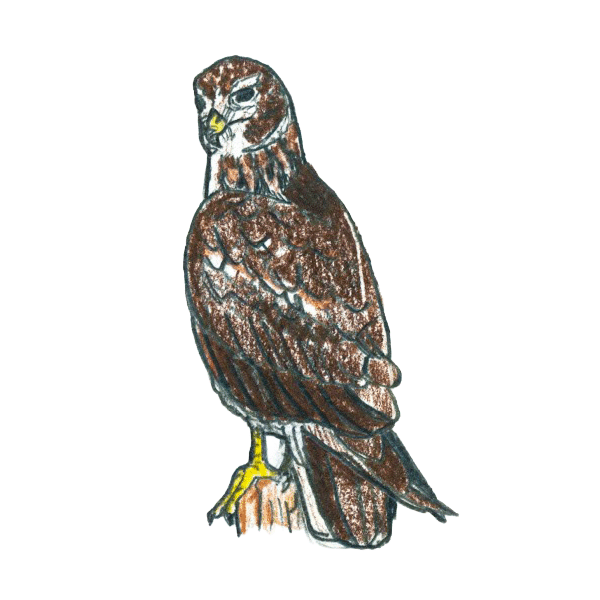 Northern Harrier
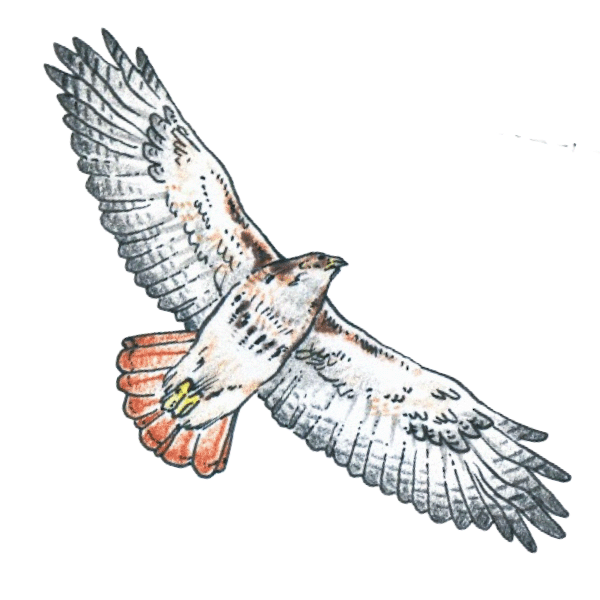 Red-Tailed Hawk
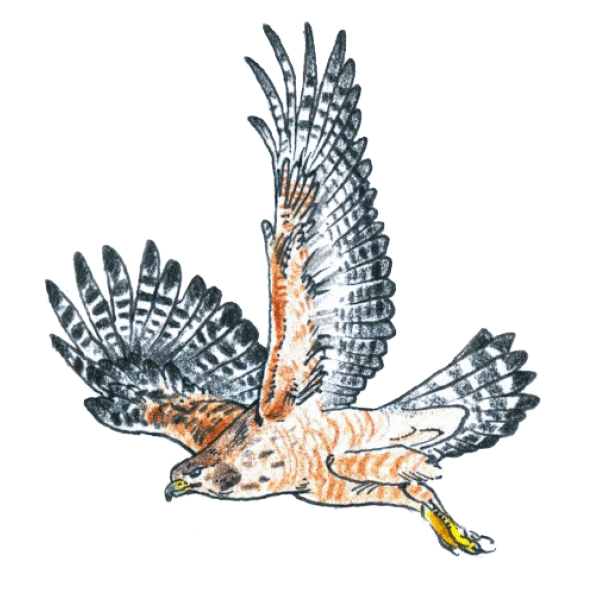 Red-Shouldered Hawk
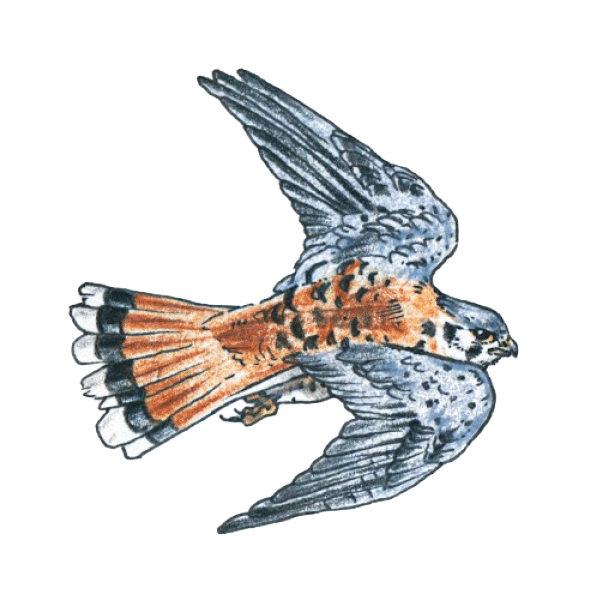 American Kestrel
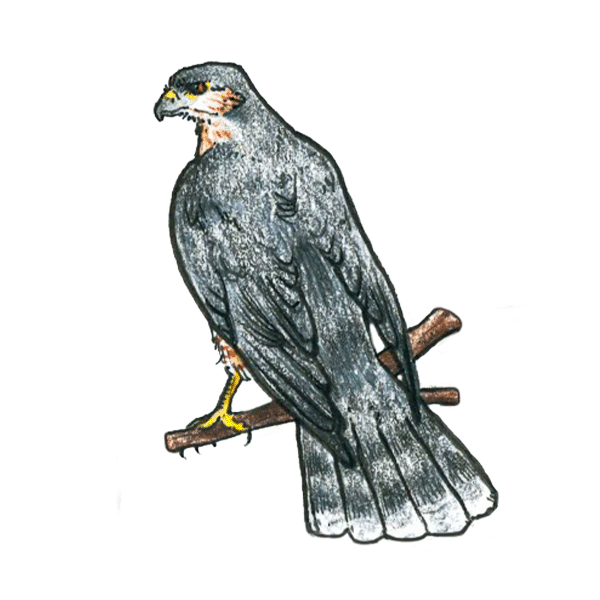 Sharp-Shinned Hawk
Through the windshield, they spot something: hidden in a tree up ahead is an adult red-tailed hawk—Iowa’s most common year-round raptor. “And there’s a second!” says Conrads, training his binoculars to a nearby mate. Red-tails are distinguished not just by their cinnamon-colored tails, but also by broad, rounded wings spanning 4 to 5 feet. Their pale undersides tell us these two are light morphs, Conrads explains, as opposed to dark morphs with brownish bellies.
Dorrance logs the red-tails on his clipboard. He also notes the GPS coordinates, time, morph, sex, and whether it’s a juvenile or adult. Later, that data will be entered into the Hawk Migration Association’s winter raptor survey database, which is used by researchers, land management agencies, and birding organizations to track population trends.
Red-tails are also the subject of a budding Iowa Raptor Project collaboration with Cornell University’s prestigious ornithology lab, Conrads tells us. As part of the Red-Tailed Hawk Project, UI researchers hope to band, photograph, and take feather samples to document the five subspecies of red-tails found in Iowa during the winter months. By studying one of North America’s most familiar raptors, researchers hope to answer broader questions about raptor ecology and evolution.
“Red-tailed hawks are everywhere,” Conrads says. “You’ve heard the phrase ‘familiarity breeds contempt’—with red-tails, it’s more like familiarity breeds apathy. ‘Oh, it’s just a red-tail.’ But there are still a lot of questions about them.”
Conrads deputizes the magazine team as official surveyors, urging us to scan the skies and timberline while giving us a crash course on Iowa’s native raptors and snowbirds. His enthusiasm is infectious. In the back seats, Beecher, Diehl, and I crane our necks, eager for the next sighting. Soon, Beecher calls out another red-tailed hawk, and Dorrance adds it to a log that is quickly filling.
Near a marshy area known as Swan Lake, we spy the snow-capped head of a bald eagle. Once a rare sight in Iowa, they’ve become increasingly common—particularly near prime fishing waters like the Iowa River. Thanks to decades of conservation efforts, bald eagles were removed from the national list of threatened and endangered species in 2007.
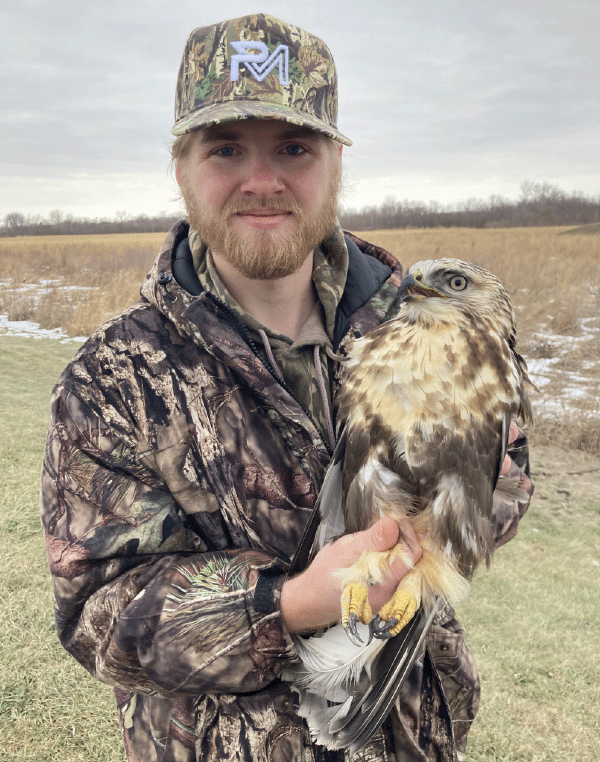 Photo courtesy Dave Conrads / Iowa Raptor Project
Iowa Raptor Project volunteer and UI REACH program alumnus Aaron Petrie holds a rough-legged hawk during a banding outing last year.
Photo courtesy Dave Conrads / Iowa Raptor Project
Iowa Raptor Project volunteer and UI REACH program alumnus Aaron Petrie holds a rough-legged hawk during a banding outing last year.
A few minutes later, Dorrance passes the binoculars back to us. This time: a medium-sized raptor that remains on the state’s endangered species list. The northern harrier—an owl-faced bird whose silver-feathered males are nicknamed the “gray ghost”—can be found in Iowa year-round, though its population has declined due to the loss of grassy habitat it needs to hunt.
Next, we step out of the Suburban for a better view of two raptors in flight. At first glance, they resemble red-tails, but Conrads knows better. They’re red-shouldered hawks, he explains—another endangered species in Iowa. The medium-sized raptors have rich, reddish-brown chests, black-and-white checkered wings, and striped tails.
“Nothing else is shaped like that, flies like that, in a habitat like that—it rules out everything else,” says Conrads. “If you do this long enough, it all comes together.”
Later, as I scan the snow-splotched marshland through a back window, I note a dark shape on the ground. A jolt of excitement—I call it out. Conrads slows the SUV, but there’s no need to log this one. It’s just a crow, he confirms through his binoculars.
“That’s a special sighting. This has my heart pounding.” —Dave Conrads on the dark morph rough-legged hawk
Just as deer hunters begin to see mirages of bucks after hours in a tree stand, Conrads says birders can experience a similar kind of buck fever. It’s easy to mistake, say, a mourning dove for a raptor like an American kestrel, he says. Or in my case, a very average crow for a hawk.
Still, many of Iowa’s non-raptors are worth a closer look. When a cherubic, brownish-gray songbird with a black mask darts past the SUV, Petrie tells us not to be fooled by its looks. It’s a northern shrike, otherwise known as “the butcher bird” because of its taste for mice, shrews, and general violence. “It’s the most vicious songbird,” says Petrie. “Whatever they kill, they’ll impale it on a barbed wire fence or a branch to eat later.”
Midmorning, we pull off to the shoulder to fix our binoculars on a dark raptor high in the sky. Diehl snaps away with his camera. We watch it glide and turn in the wind, circling the field. A dark morph, rough-legged hawk, the three experts agree. These large raptors breed and nest in the Arctic but winter in southern Canada and the U.S.
Conrads and Dorrance exchange a high five. “That’s a special sighting,” says Conrads. “This has my heart pounding.”
Sometime before noon we pull into Casey’s in Amana for coffee and provisions. I do not impale my breakfast pizza on a fence post.
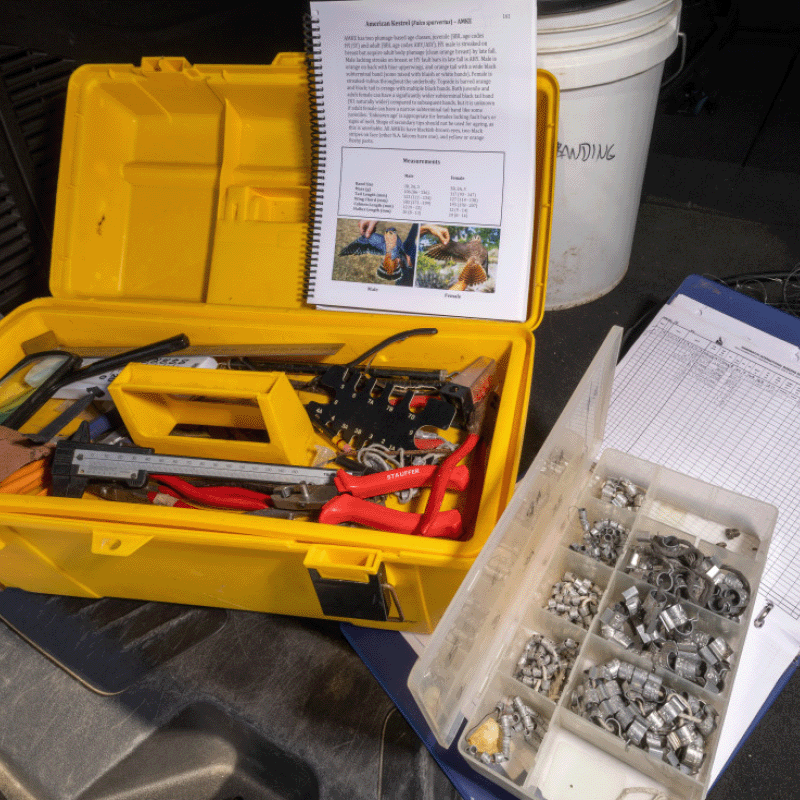
Tools of the Trade
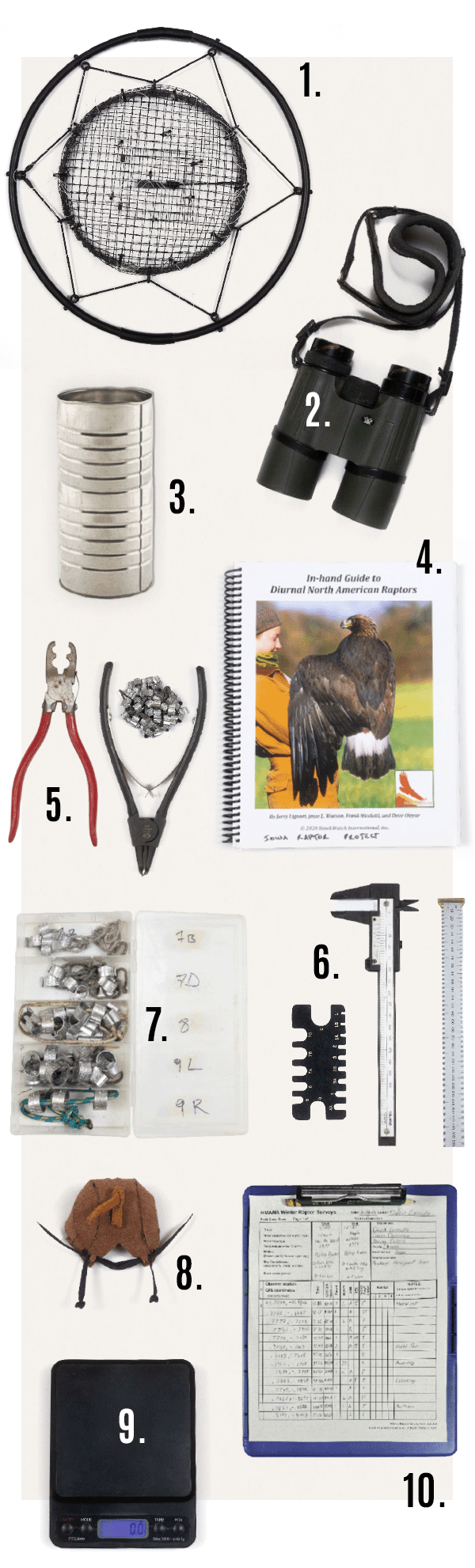 The Bird Banding Toolkit
1. Bal-chatri trap
2. Binoculars
3. Can to minimize movement and reduce stress
4. Bird identification guide
5. Banding pliers
6. Measurement tools
7. Box of banding rings
8. Hood to remove visual stimulation
9. Digital scale
10. Clipboard with survey tally
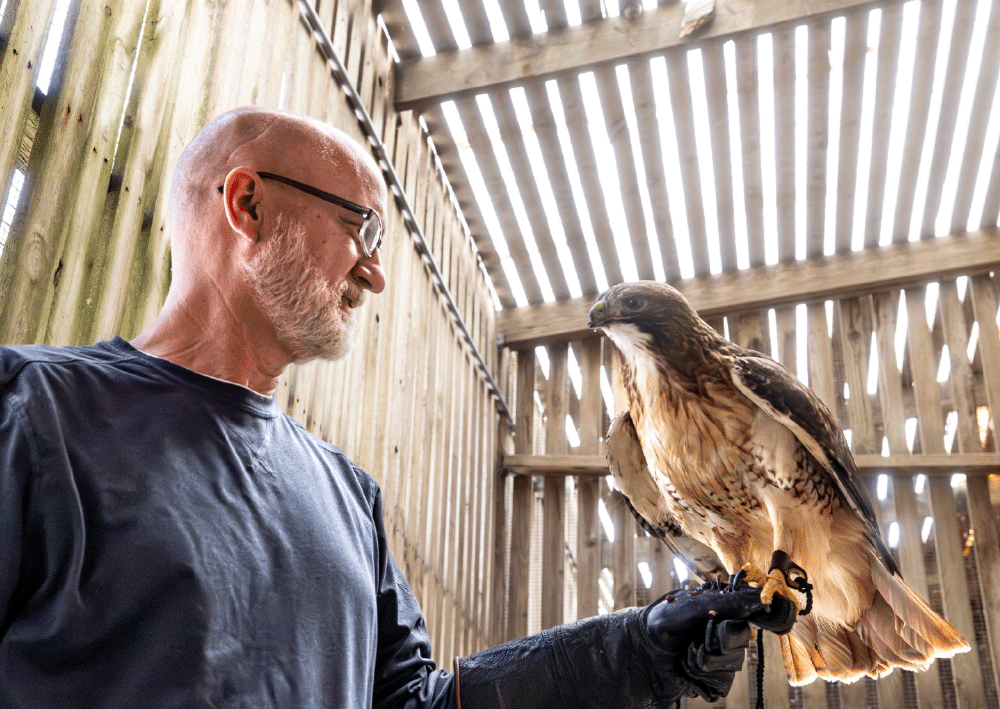
A week before the bird count, Diehl and I meet Conrads at the Iowa Raptor Project headquarters at Macbride Nature Recreation Area. Inside a roomy, wood-slatted enclosure, he introduces us to the center’s newest resident. Conrads offers up a dead rodent, and a red-tailed hawk named Forty leaps onto his gloved arm.
Forty first arrived at the World Bird Sanctuary in St. Louis in early 2025 with a bill injury that made it impossible to tear apart its prey. The sanctuary reached out to Iowa, and Conrads agreed to take in the 3-year-old hawk as one of the center’s raptor ambassadors.
The name came from its intake number: the 40th bird admitted that year at the sanctuary. But it stuck for other reasons. The Iowa Raptor Project marked its 40th anniversary in 2025, and the number also carries Hawkeye resonance, a nod to the late basketball player Chris Street, whose No. 40 jersey hangs in Carver-Hawkeye Arena.
Forty is one of 13 residents at the Iowa Raptor Project—birds that can’t survive in the wild and are cared for by licensed staff as part of the center’s educational work. Others include Hercules, a red-tailed hawk who has thrilled football fans with flyovers at Kinnick Stadium in recent years, and Spirit, an elderly bald eagle who has been with the program since 1989. Together, they serve as ambassadors for UI WILD, the university’s broader conservation education program designed to connect Iowans with the outdoors.
Conrads has been part of that work for most of his career. He arrived at the UI in 1990 after earning a master’s degree in biology from the University of Northern Iowa and went on to expand Iowa’s outdoor education programs, founding Iowa Wildlife Camps and School of the Wild, a statewide initiative for elementary and middle school students. In the early 2000s, he left academia to attend seminary in Michigan, later returning to Iowa to establish Genesis Church in Coralville, where he serves as pastor. He rejoined the university full time in 2013 to lead UI WILD before transitioning back into fieldwork and leadership at the Iowa Raptor Project in 2024.
“My graduate work was on Cooper’s hawks and sharp-shinned hawks,” says Conrads. “It’s been 30 years since I’ve been active in the field, so it’s been fun to get back into it.”
Recent years have brought both loss and uncertainty. A 2024 fire swept through several enclosures and killed four raptors—a devastating blow for staff and volunteers. Then last year, the UI announced it will not renew its lease of the Macbride Nature Recreation Area with the U.S. Army Corps of Engineers when it expires in 2029, meaning the Raptor Project and other UI WILD programs will eventually relocate.
“This facility has served us well, but there are also limitations here,” Conrads says. “So who knows how it’ll play out?”
BANDING IOWA RAPTORS
AMERICAN KESTREL
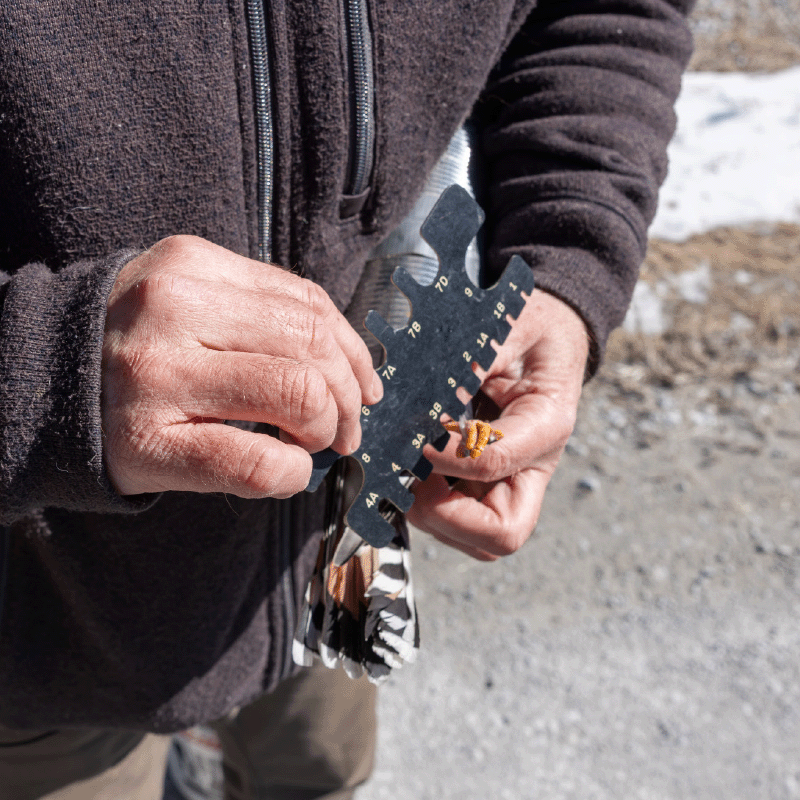
By early afternoon, after completing our survey loop of northwestern Johnson County, Dorrance tallies the clipboard: 15 red-tailed hawks, 10 bald eagles, four northern harriers, two red-shouldered hawks, one rough-legged hawk, and one buteo of unknown species.
In other words, 33 more raptors than I would have identified—or likely even spotted—without the eagle eyes of Conrads, Dorrance, and Petrie. My crow does not make the list.
Before calling it a day, Conrads has one last item on the agenda: capture and band a raptor. Each year, Iowa Raptor Project staff and students band migrating diurnal raptors like hawks, as well as nocturnal raptors like northern saw-whet owls, to help researchers better understand their longevity and movement along the Iowa River valley and surrounding region. They also band hundreds of migrating and nesting songbirds.
“Through capture and recapture statistics, you can estimate populations of breeding birds, and if you do that over a longer period of time, you can learn about what birds are declining, what birds are gaining ground, what birds are stable,” says Conrads.
In the passenger seat, Petrie readies a raptor trap known as a bal-chatri. The lightweight wire cage holds and protects two live sparrows—lures that Conrads, who is a licensed bird bander, caught the day before in anticipation of the outing. Affixed to the domed top is a web of fine nooses designed to safely snare a raptor’s legs when it strikes.
Conrads steers the SUV down a country road as we scan treetops for birds of prey—for now, our prey. “Now we’re trolling,” he says.
 PHOTOS: John Emigh
Dave Conrads is pictured with the Iowa Raptor Project's newest ambassador, a red-tailed hawk named Forty. The name is a nod to Hawkeye legend Chris Street.
PHOTOS: John Emigh
Dave Conrads is pictured with the Iowa Raptor Project's newest ambassador, a red-tailed hawk named Forty. The name is a nod to Hawkeye legend Chris Street.
Near the west edge of the Hawkeye Wildlife Management Area, the birders spot an American kestrel on a powerline. Conrads slows the Suburban. Petrie rolls down the window and gently tosses the trap, frisbee-like, into the ditch. We drive a few dozen yards down the road where we wait, like cops on a stakeout. A moment later, the silent hunter drops onto the trap.
Then, a plot twist. “There’s a sharpie!” says Conrads, spotting a second bird in pursuit.
We speed back to find a scene that stuns even Conrads. Not one but two raptors are tangled atop the trap. The American kestrel—a small falcon—reached the sparrows first, only to be attacked by a sharp-shinned hawk, or “sharpie.”
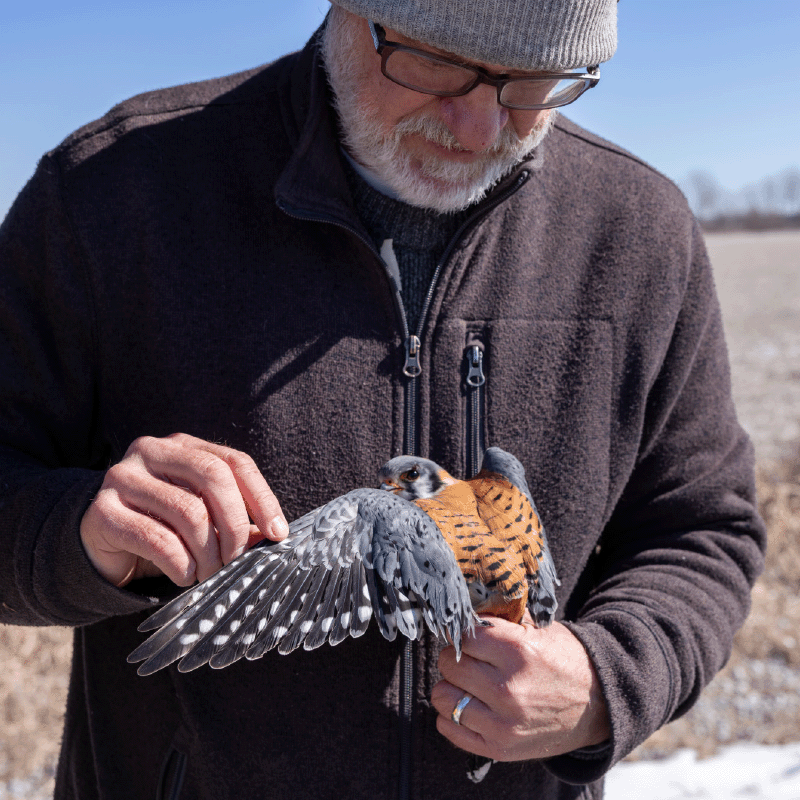
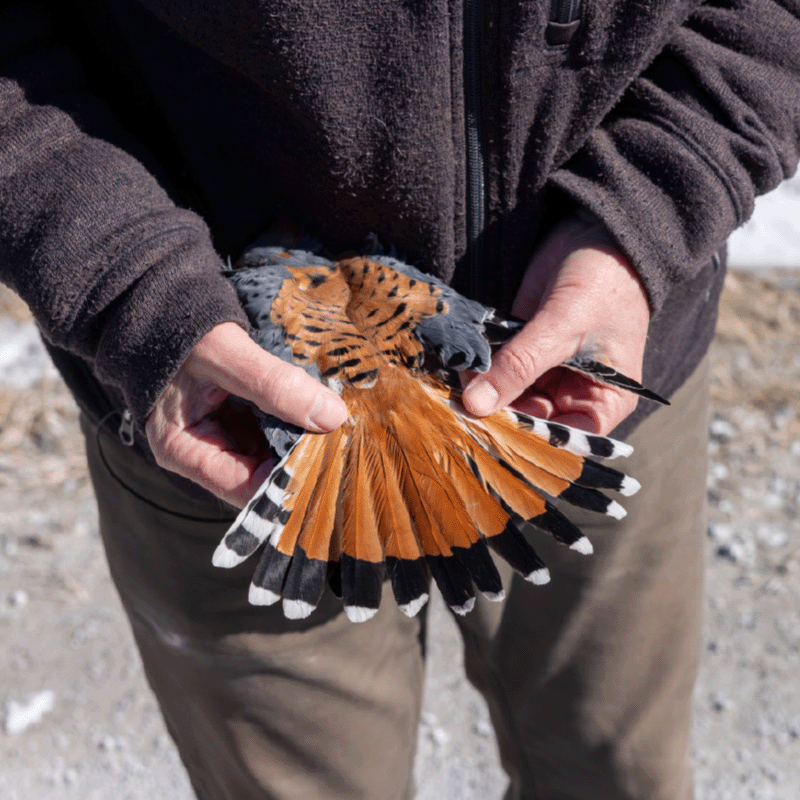
The sharpie frees itself and takes off, but the kestrel is ensnared. Conrads and Dorrance work quickly to free its talons and check for injury. It’s alive but stunned. We huddle around to admire the bird in a hushed kind of reverence. Slate blue wings, rust-colored plumage that looks almost tiger-striped, and a white- and black-checkered tail. Of all the raptors we saw today, this one looks the most like it came from a fairytale.
“The etymology of hawk is akin to havoc. And we witnessed true havoc in that brief moment.” —Dave Conrads
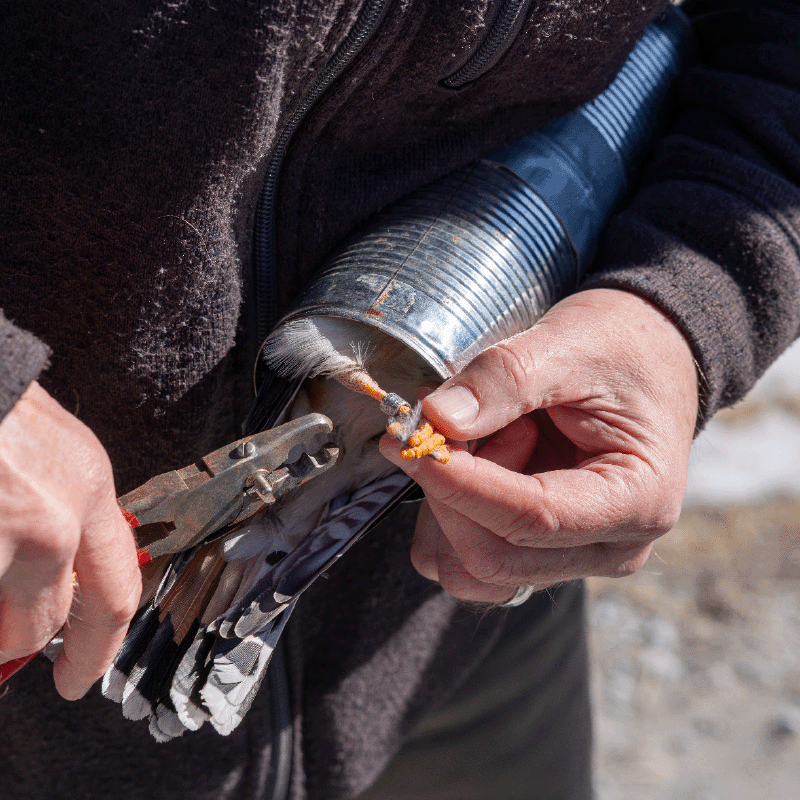
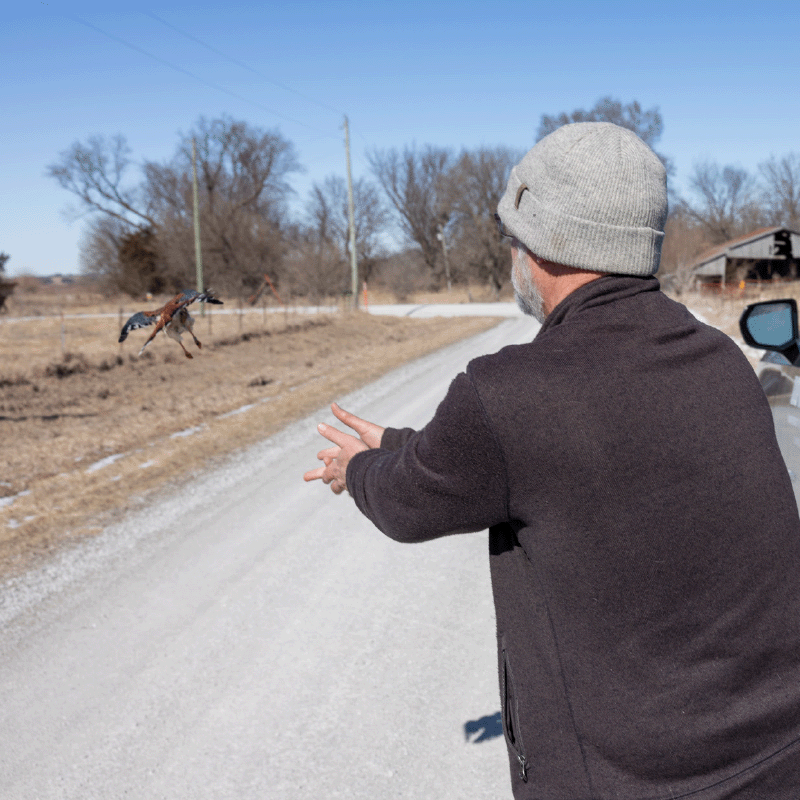
Conrads measures the kestrel’s wings and records its data, then slides it into a metal restraint cylinder. With a pair of pliers and the steady hand of a surgeon, he fits a small metal band around its leg. The band has a unique number and contact information for future identification if the bird is recaptured or found by the public. With its new ID band in place, he frees the kestrel from the tube and sets it in the roadside brush to regain its bearings.
“I’ve been doing this for 40 years and I’ve never seen this before, where we’ve had a bird go for another bird,” Conrads says. “That was insane.”
A day after our expedition, Conrads is still reflecting on its unexpected conclusion—a lesson in nature’s unpredictability. “The etymology of hawk is akin to havoc,” he tells me in an email. “And we witnessed true havoc in that brief moment.”
The outing stays with me too. I find myself paying closer attention to the big birds patrolling the skies outside my office window. On drives home, I spot bald eagles perched statue-like above the Iowa River. Sometimes I stand on my back porch, hoping to catch another glimpse of a magical kestrel.
One sunny afternoon, on a spring break road trip with my family, a winged shadow crosses the highway. I glance up from the steering wheel to see a raptor with a white belly and rounded wings.
“Look,” I say. “A red-tail!”
Tools of the Trade
The Bird Banding Toolkit1. Bal-chatri trap
2. Binoculars
3. Can to minimize movement and reduce stress
4. Bird identification guide
5. Banding pliers
6. Measurement tools
7. Box of banding rings
8. Hood to remove visual stimulation
9. Digital scale
10. Clipboard with survey tally