
The Thrill of Discovery: Kevin Campbell Inspires Young Researchers
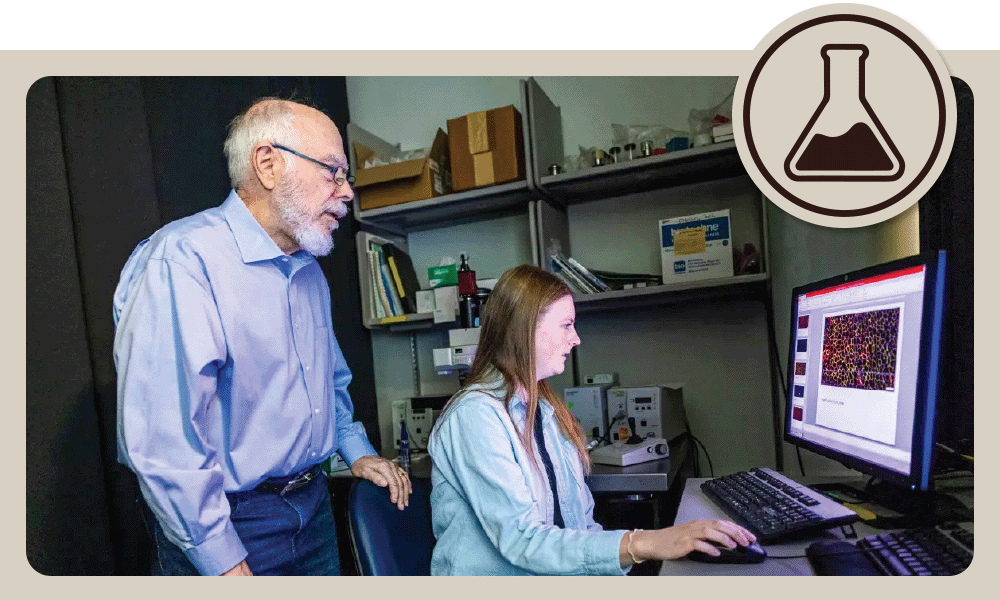 PHOTO: LIZ MARTIN/UI CARVER COLLEGE OF MEDICINE
Kevin P. Campbell in his lab with graduate research assistant Emma Luhmann
PHOTO: LIZ MARTIN/UI CARVER COLLEGE OF MEDICINE
Kevin P. Campbell in his lab with graduate research assistant Emma Luhmann
Early in his career at the University of Iowa, Professor Kevin P. Campbell tried to do everything himself in the lab.
One weekend, however, a student offered to monitor the gels they were running—a common technique to separate biomolecules. When Campbell returned on Monday, he was greeted by his excited student eager to share the results.
“I realized that in science, to get people really motivated, you sometimes need to step aside and let people experience the thrill of discovery for themselves,” Campbell says. “As scientists, we’re addicted to that rush you get when you see results,” he adds. “But if you give that to a young person, and they get it, you’ve got them hooked.”
In the decades since, Campbell has been instrumental in helping young scientists develop a passion for discovery in his lab, where they work to better understand muscular dystrophy and pave the way for improved therapies and potential cures.
“I like solving problems. For me, that’s what science is,” says Campbell, professor and chair of the Department of Molecular Physiology and Biophysics. “And muscular dystrophy is a problem I want to solve.”
Muscular dystrophy refers to a group of inherited conditions that affect muscle structure and function, leading to progressive muscle weakness, reduced mobility, and shortened lifespan. In some cases, it also causes severe cardiac and respiratory complications, as well as neurological impairment.
Campbell has been a leader in muscular dystrophy research since joining the UI faculty in 1981. His discoveries in muscle cell biology helped lay the foundation for new approaches that have improved the diagnosis and treatment of the disease. Building on his lab’s work, scientists are moving closer to therapies that may correct or even reverse the progression of muscular dystrophy.
For more than 40 years, Campbell has guided colleagues and trainees in his lab while collaborating with scientists around the world. In 2005, he received the Carver College of Medicine Distinguished Mentor Award.
Physician Ronald Cohn, president and CEO of the Hospital for Sick Children in Toronto, was a postdoctoral fellow in Campbell’s lab from 1998–2001 and remains in touch with his former mentor. He says that in his work as a hospital administrator and clinician, he still draws upon the lessons learned under Campbell.
“You look at Kevin’s career and all the fundamental discoveries that he, with his laboratory, has helped us understand—not just about Duchenne muscular dystrophy but many other muscular dystrophies,” Cohn says. “You can only do that if you have that kind of special, creative, critical thinking. And to me, that’s probably one of the main reasons for his success.”