
Kinnick Stadium DJ Curates Hawkeye Football Soundtrack
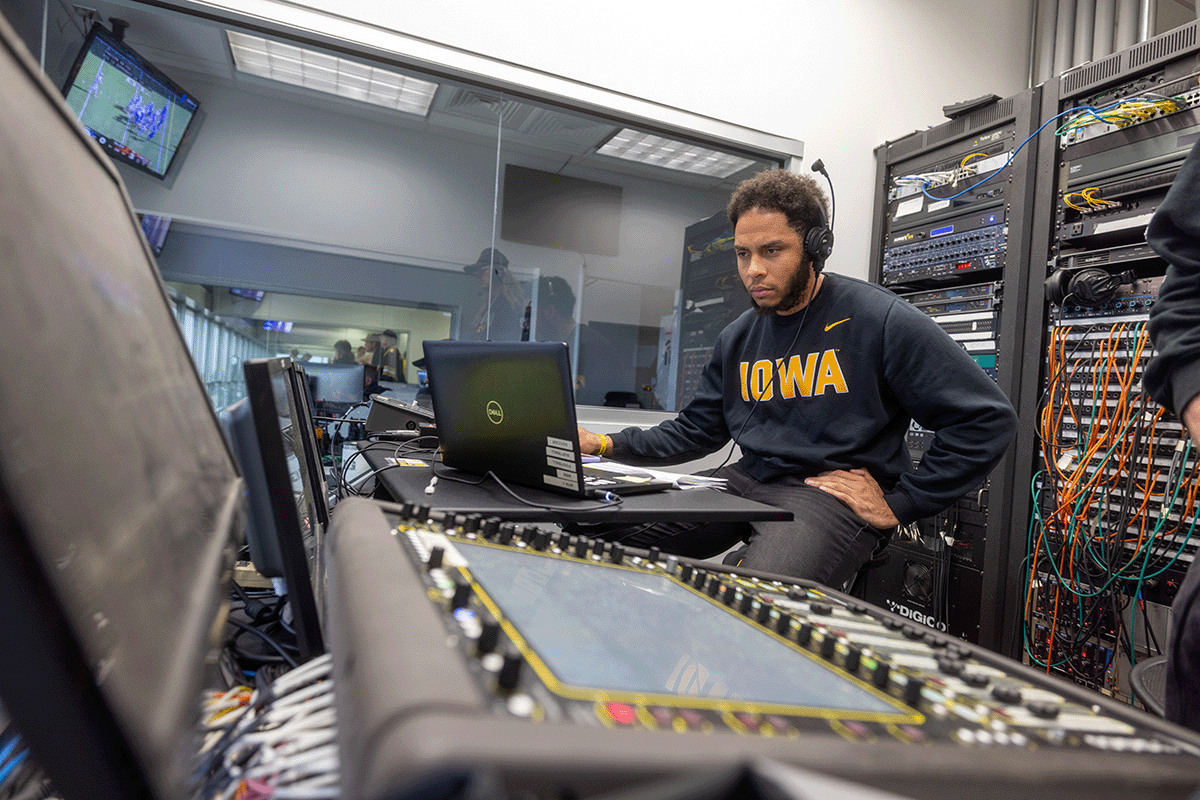 PHOTO: John Emigh
Kinnick Stadium DJ Demarcus Heglar focuses on the field and the crowd from the public address booth in the press box to determine which song he’ll play next. He organizes 400 options for each game that are neatly categorized on his laptop and will play between 80 to 100, carefully matching or shaping the mood in the stadium.
PHOTO: John Emigh
Kinnick Stadium DJ Demarcus Heglar focuses on the field and the crowd from the public address booth in the press box to determine which song he’ll play next. He organizes 400 options for each game that are neatly categorized on his laptop and will play between 80 to 100, carefully matching or shaping the mood in the stadium.
Demarcus Heglar can energize 70,000 fans with the push of a button. As Iowa’s opponent marches deeper into Hawkeye territory and faces a pivotal third down, Heglar leans over his desk, glances down at his laptop, and awaits the precise moment to press play.
All aboard! Ha ha ha ha ha ha ha.
The iconic intro to Ozzy Osbourne’s “Crazy Train” pulses through Kinnick Stadium, inviting the sellout crowd along for the ride. The bass line thumps, the vibraslap rattles, and Hawkeye fans know just what to do: GET LOUD! Regardless of what happens on the play, Heglar has done his job of fully engaging the crowd. Still, his eyes remain fixed on the field as he plots his next move.
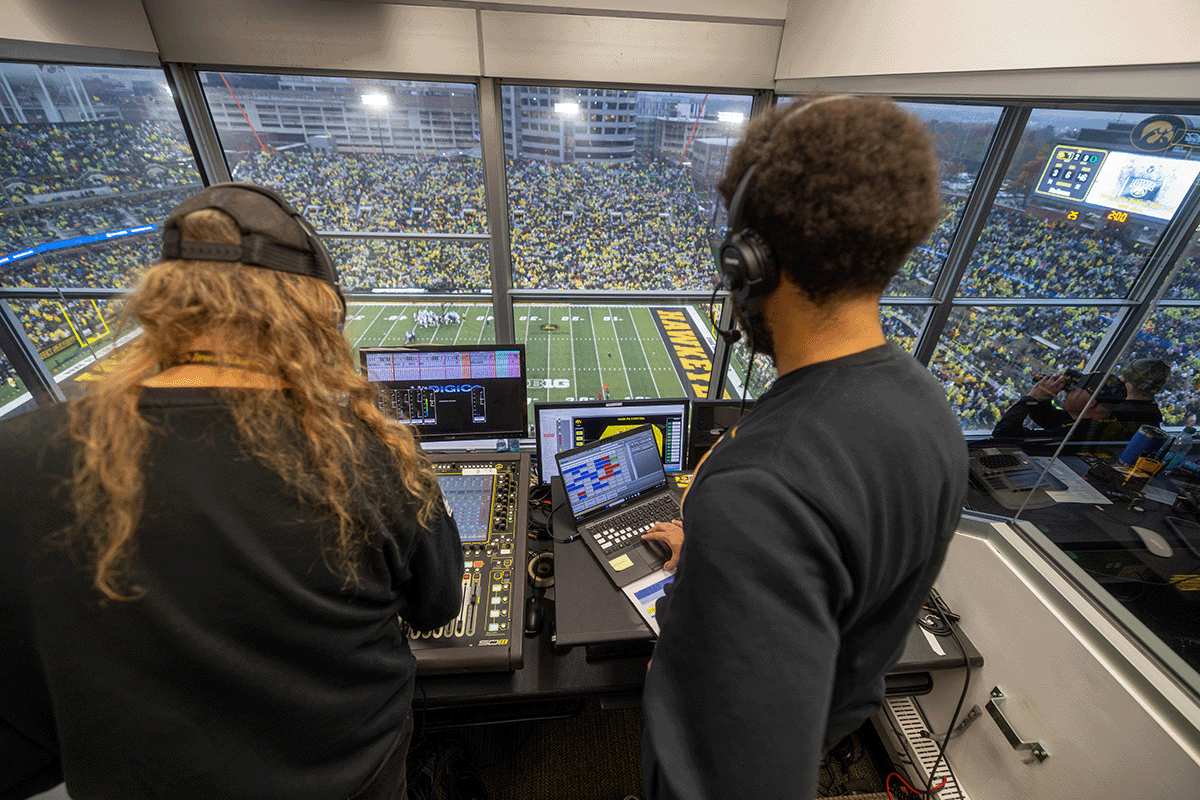 PHOTO: John Emigh
Sound technician Rick Von Lienen, left, manages the sound levels within Kinnick Stadium, including the volume from video board speakers and the microphones of the head official and host Laura VandeBerg. Kinnick DJ Demarcus Heglar plays a song on his laptop while cueing up a couple more for later. Unplayed selections he’s chosen for this game are highlighted in blue and turn red after they’re played.
PHOTO: John Emigh
Sound technician Rick Von Lienen, left, manages the sound levels within Kinnick Stadium, including the volume from video board speakers and the microphones of the head official and host Laura VandeBerg. Kinnick DJ Demarcus Heglar plays a song on his laptop while cueing up a couple more for later. Unplayed selections he’s chosen for this game are highlighted in blue and turn red after they’re played.
Heglar is the DJ for every Hawkeye home football game and meticulously organizes his music, so he has the right song ready for any moment. The UI athletics assistant director of marketing curates a playlist of 400 songs that’s organized in groups to match specific scenarios throughout game day. Inspiration for new additions can strike anywhere—from social media to hearing a song played on a Tuesday night Mid-American Conference football telecast. Heglar moves his go-to anthems higher on the playlist, while songs that he played the week before may get bumped down. He keeps track of songs he’s already used, but that doesn’t mean he can’t return to them later if they created the desired effect.
Heglar often works a few steps ahead, anticipating what will happen and cueing up songs while being ready to pivot. He pays close attention to the action on the field, the vibe in the stands, and the game day operations script on his desk to inform his choices. Third-down situations are critical, as it’s when Heglar wants the fans at maximum volume to fire up the Hawkeye defense and create confusion for the opponent. Feeding off the crowd’s energy, Heglar may play three consecutive “third-down songs” if the moment calls for it, such as when an opponent is backed up near their own end zone. “If [fans are] already loud and excited, I want to be the kerosene on the fire to get them going even more,” says Heglar, who plays 80–100 songs per game. “I try to get the crowd as engaged as possible to use them as our 12th man.”
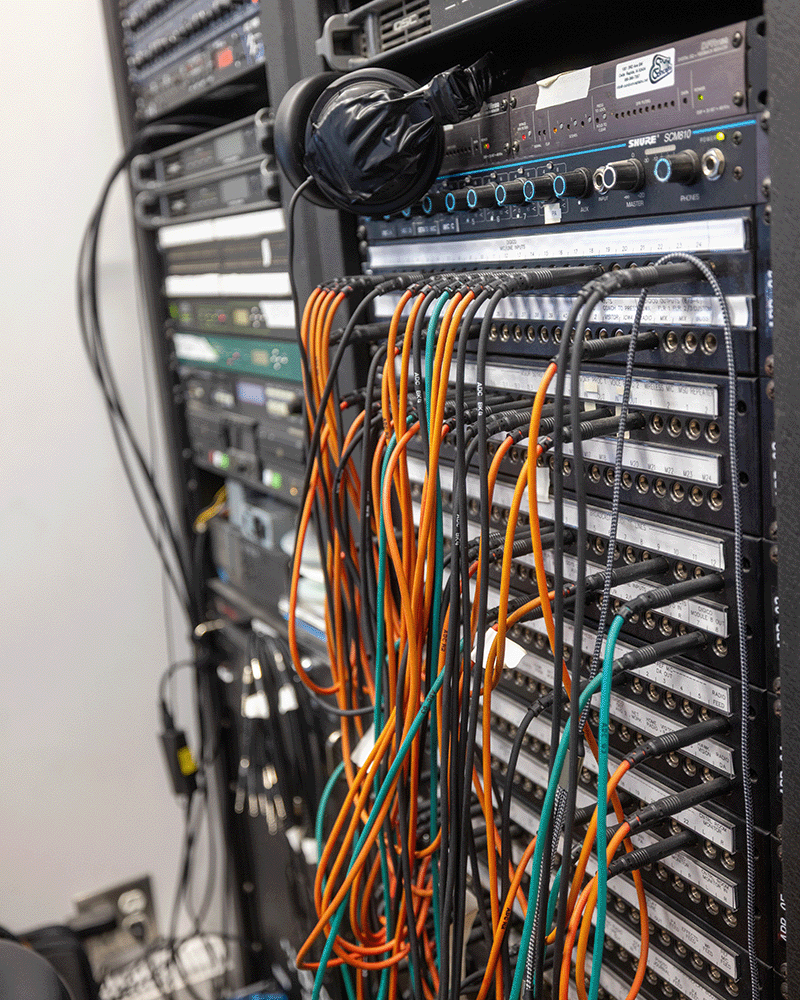 PHOTO: John Emigh
More than 50 radio frequencies are used at an Iowa football game, including home and visitor team radio stations and microphones for the Iowa band, the referee, and Hawkeye host Laura VandeBerg. The audio team also uses on-field microphones to capture crowd noise, which is pumped into the press box seating areas where fans are seated inside behind windows so that they feel more of the stadium energy. Frequency coordinator Claude Spears uses a spectrum analyzer to ensure two parties aren’t using the same radio frequency.
PHOTO: John Emigh
More than 50 radio frequencies are used at an Iowa football game, including home and visitor team radio stations and microphones for the Iowa band, the referee, and Hawkeye host Laura VandeBerg. The audio team also uses on-field microphones to capture crowd noise, which is pumped into the press box seating areas where fans are seated inside behind windows so that they feel more of the stadium energy. Frequency coordinator Claude Spears uses a spectrum analyzer to ensure two parties aren’t using the same radio frequency.
Brian Clarke, UI athletics director of marketing, communicates with Heglar via headset to coordinate their approach to upcoming game scenarios. Clarke looks for ways to maximize fan engagement, such as pairing a jumbotron visual of fans getting hyped with a “third-down song” to increase the energy within the stadium on a key drive. “Enthusiasm is contagious,” says Clarke. “And that’s why it’s important to show the fans responding and to hit them with the right song at the right moment.”
Heglar carefully paces fans with his song choices, especially early in the game, to avoid wearing them out. It’s often in the second half when their energy is needed most. When there’s a lull in the game, such as a replay review, Heglar plays upbeat pop songs to keep a lively atmosphere. He leans further into celebratory anthems when the Hawkeyes are playing well or score a touchdown, and dials things back slightly when the team is struggling.
Heglar enters his third season as DJ this fall and remembers his first game fondly. That’s when he fully realized the influence his work can have on Kinnick game day. “Being able to harness the crowd, 70,000 people,” says Heglar, “and to prompt the fans to do what we need them to do in a given moment is really cool.”
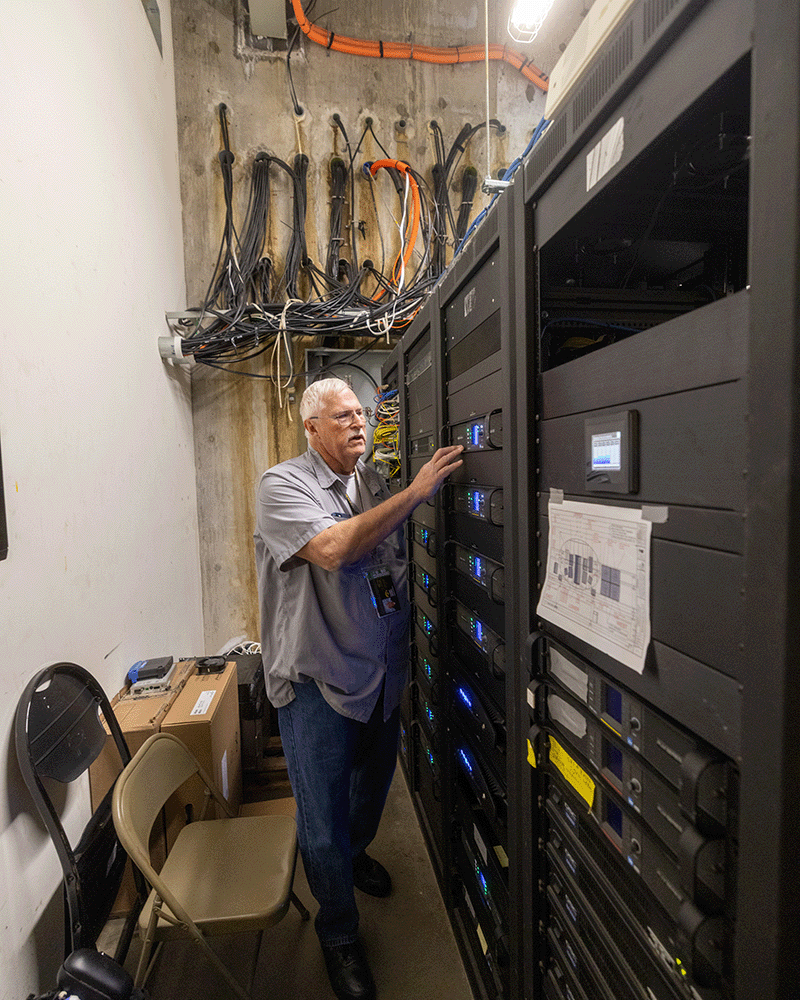 PHOTO: John Emigh
Frequency coordinator Claude Spears checks a display screen in the amp room deep within Kinnick Stadium. During the game, Spears moves around the stadium to ensure sound levels are at an appropriate decibel level. With the stadium’s proximity to UI Health Care Stead Family Children’s Hospital, Spears and his team aim to keep the sound level at the top of the stadium bowl near the hospital at 90 decibels or below. If the sound reaches or surpasses 92 decibels in that area, they must file a report to explain why it happened.
PHOTO: John Emigh
Frequency coordinator Claude Spears checks a display screen in the amp room deep within Kinnick Stadium. During the game, Spears moves around the stadium to ensure sound levels are at an appropriate decibel level. With the stadium’s proximity to UI Health Care Stead Family Children’s Hospital, Spears and his team aim to keep the sound level at the top of the stadium bowl near the hospital at 90 decibels or below. If the sound reaches or surpasses 92 decibels in that area, they must file a report to explain why it happened.
KINNICK GAMEDAY
Game Day Go-Tos
Demarcus Heglar shares some of his staple songs from the 2025 season. Warning: Some songs contain explicit lyrics.