
Event Management and Security Ensure Safe Kinnick Stadium Environment
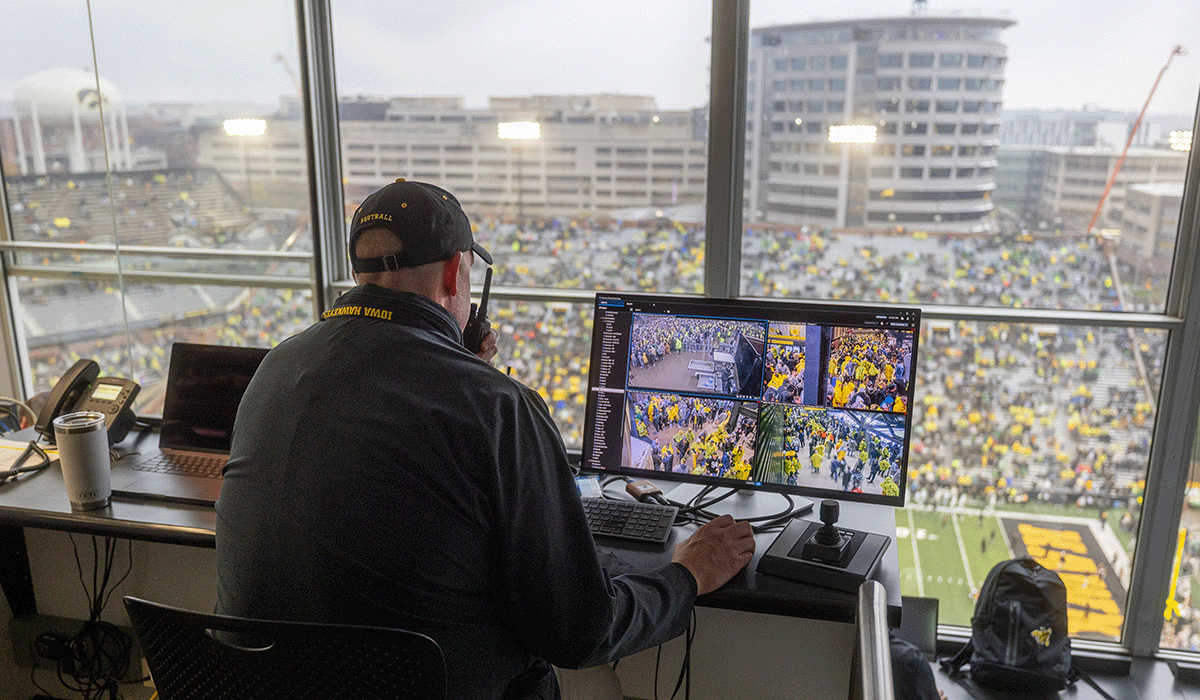 PHOTO: John Emigh
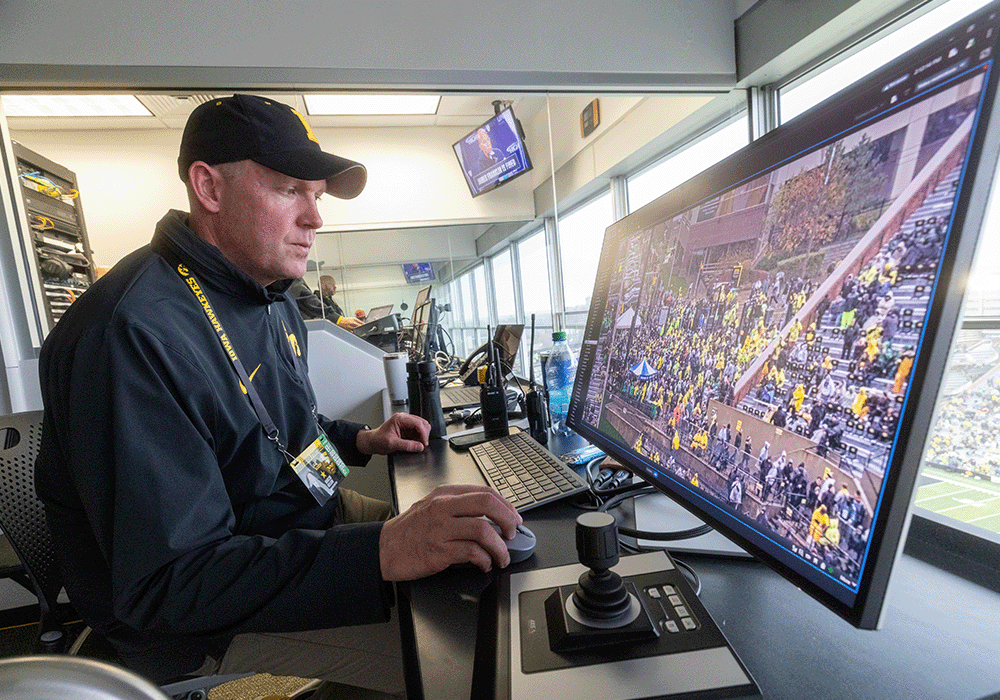
Marcus Wilson, executive senior associate athletics director, monitors live video feeds in the command center from cameras throughout the stadium and surrounding parking areas. He communicates with contracted security staff to address pinch points and other stadium concerns and works closely with Dave Visin, who coordinates law enforcement responses.
PHOTO: John Emigh
Marcus Wilson, executive senior associate athletics director, monitors live video feeds in the command center from cameras throughout the stadium and surrounding parking areas. He communicates with contracted security staff to address pinch points and other stadium concerns and works closely with Dave Visin, who coordinates law enforcement responses.
Thousands of fans wearing ponchos flood the Kinnick Stadium concourses, seeking shelter from the chill of a steady rain. Kickoff is less than 30 minutes away, and as many fans try to stay warm and dry as long as possible before finding their seats, pedestrian traffic jams form in the stadium. Marcus Wilson watches the crowd activity on a large monitor in the stadium’s command center from the fourth floor of the press box. He views multiple camera angles throughout the stadium and communicates via two-way radio with event operations personnel to alleviate any bottlenecks or other crowd control issues.
Click to enlarge
Wilson, the executive senior associate athletics director of sport operations and event management, is joined in the command center by staff from the UI Athletic Department, UI Police Department, UI Emergency Management, Iowa State Patrol, UI Health Care, BEST Crowd Management, Johnson County Ambulance Service, and the National Weather Service. Dispatchers field calls and triage issues as operations staff use various technologies, including artificial intelligence, to monitor crowd ingress and egress, medical emergencies, and conduct throughout the stadium. This operations hub contains a small but strong representation of the more than 1,200 personnel needed to help game day run smoothly and safely.
Action Plan
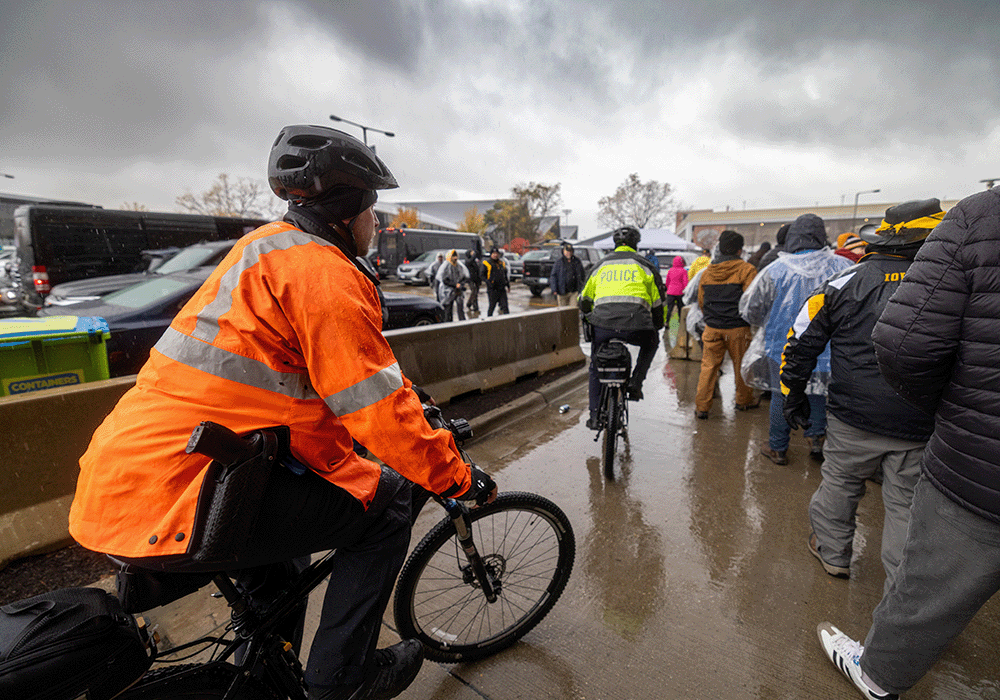 PHOTO: John Emigh
Coralville and UI police officers patrol the area around Kinnick Stadium. Bike patrol teams navigate crowded areas more quickly than vehicles, allowing for faster responses to emergencies and other calls for service.
PHOTO: John Emigh
Coralville and UI police officers patrol the area around Kinnick Stadium. Bike patrol teams navigate crowded areas more quickly than vehicles, allowing for faster responses to emergencies and other calls for service.
Josh Berka (03BS) is instrumental in coordinating the “small army” that assembles at Kinnick for several Saturdays each fall, including contract security, law enforcement, concessions workers, university and athletic department staff, student workers, and volunteers. The assistant athletics director of event management and sports camps begins preparation several months ahead of the season opener. Berka reviews his team’s policies and procedures, staff configurations at gates and parking lots, and staff redeployment once fans are in the stadium. His team also hires staff, ensuring backup is ready if volunteers drop out as the season wears on and temperatures fall.
Berka meets weekly with key stakeholders for game day operations to ensure “everyone is working from the same playbook.” They review operations from the previous game and prepare for the next, knowing each one presents unique challenges. Highly ranked opponents require preparation for a possible field storming. Threatening weather necessitates plans for moving fans to safety. Evenly matched night games often lead to congested postgame traffic.
Seven hours before kickoff, Berka arrives at the stadium carrying up to three walkie-talkies and also communicating with his staff via text. His first objective is to ensure staff are deployed in the parking lots surrounding Kinnick so they can open six hours before kickoff for contributors with passes or permits. During pregame, he verifies all game day operations staff are in position throughout the stadium. A final logistics meeting is held 100 minutes before kickoff in the visitors' media room with game officials, a broadcast TV representative, UI athletic communications staff, team representatives, an independent medical spotter, and a TV timeout coordinator. Berka aims to keep the meeting between five to seven minutes. “I always say, ‘The closer it is to five minutes, the better the day will be,’” he says.
Safe and Sound
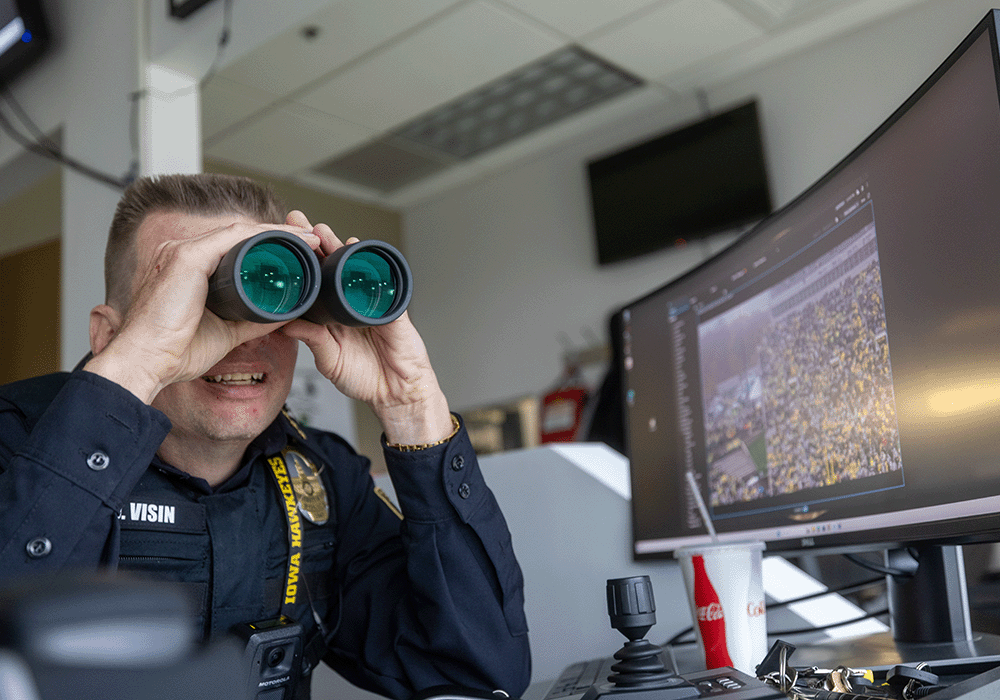 PHOTO: John Emigh
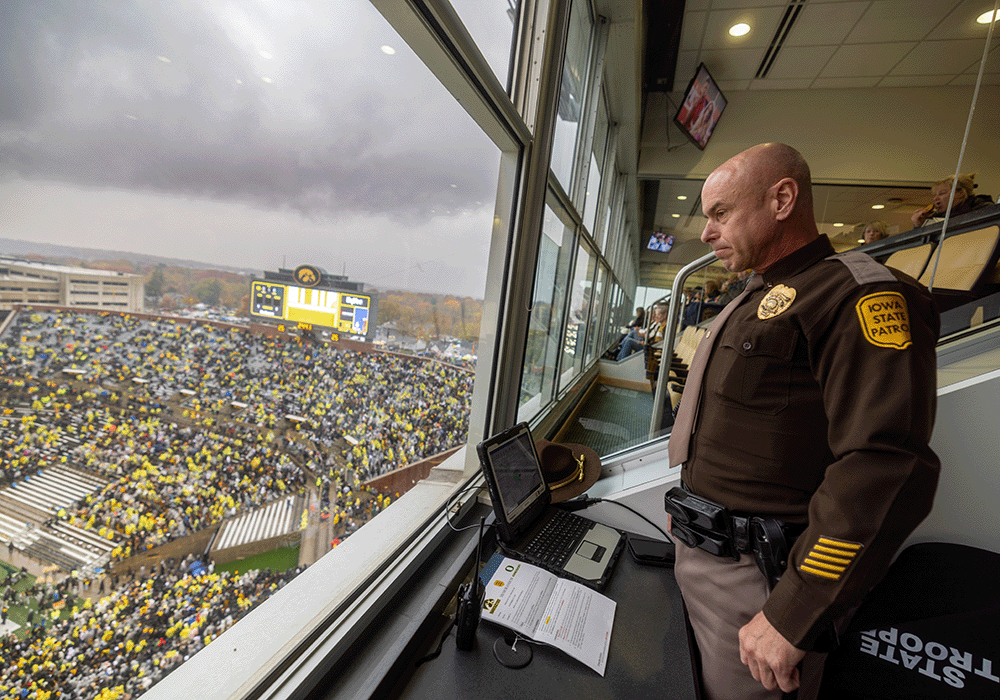
Dispatchers and key decision makers from UI Campus Safety, BEST Crowd Management, UI Health Care, Iowa State Patrol, and UI Athletics are among the 15 staff members stationed in the command center. Dave Visin, the stadium’s game day incident commander, is one of several in the command center who uses binoculars to assess multiple incidents inside the seating bowl simultaneously and gain a clearer view than what’s offered from stadium cameras.
PHOTO: John Emigh
Dispatchers and key decision makers from UI Campus Safety, BEST Crowd Management, UI Health Care, Iowa State Patrol, and UI Athletics are among the 15 staff members stationed in the command center. Dave Visin, the stadium’s game day incident commander, is one of several in the command center who uses binoculars to assess multiple incidents inside the seating bowl simultaneously and gain a clearer view than what’s offered from stadium cameras.
The UI Police Department takes control of the stadium in the days before each game, screening anyone who enters and exits. Leading up to the event, the university’s explosives detection K-9s complete sweeps of the stadium to secure it for 70,000 fans. Police departments from Iowa City, Coralville, North Liberty, Walcott, and Cedar Rapids, along with the sheriff's offices of Johnson, Linn, and Washington Counties, each have specific assignments on game day. “Like a football team, we have set plays on what we do, but we’ll typically have to call an audible because the situations are always different and we can’t preplan everything,” says Dave Visin (00BS, 14MBA), senior director for administrative and security services for UI Campus Safety. “We’ll always modify what we need to get done for everyone’s safety.”
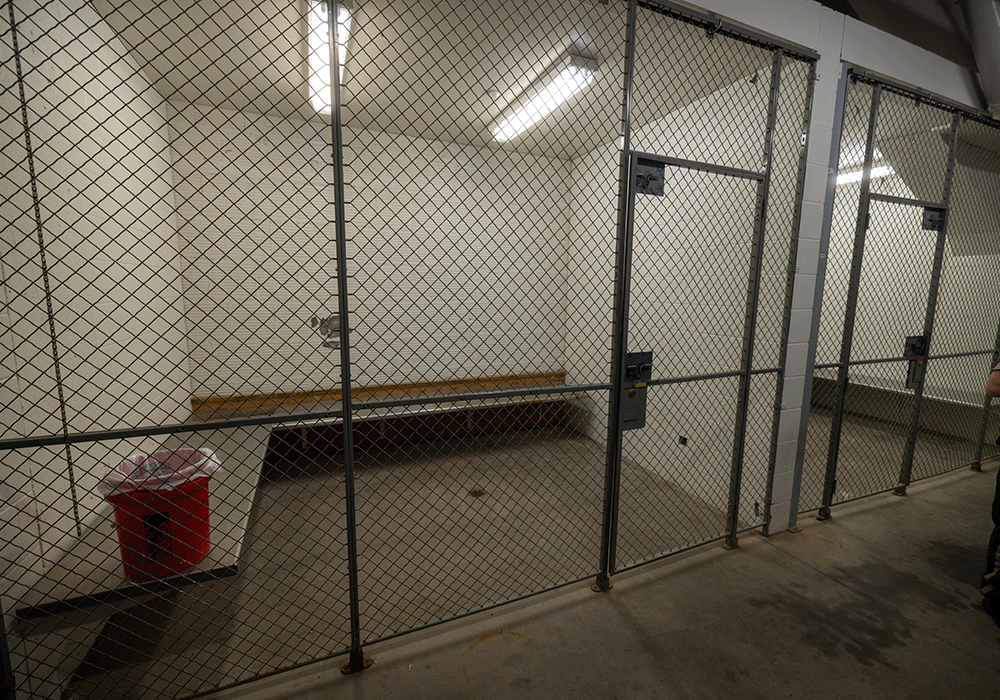 PHOTO: John Emigh
Fans who violate a stadium policy and are uncooperative can land in one of the temporary holding cells, separated for males and females. Across from the cells, a whiteboard hangs from the wall with each offender’s name, type of offense, and if applicable, their blood alcohol level inscribed in marker.
PHOTO: John Emigh
Fans who violate a stadium policy and are uncooperative can land in one of the temporary holding cells, separated for males and females. Across from the cells, a whiteboard hangs from the wall with each offender’s name, type of offense, and if applicable, their blood alcohol level inscribed in marker.
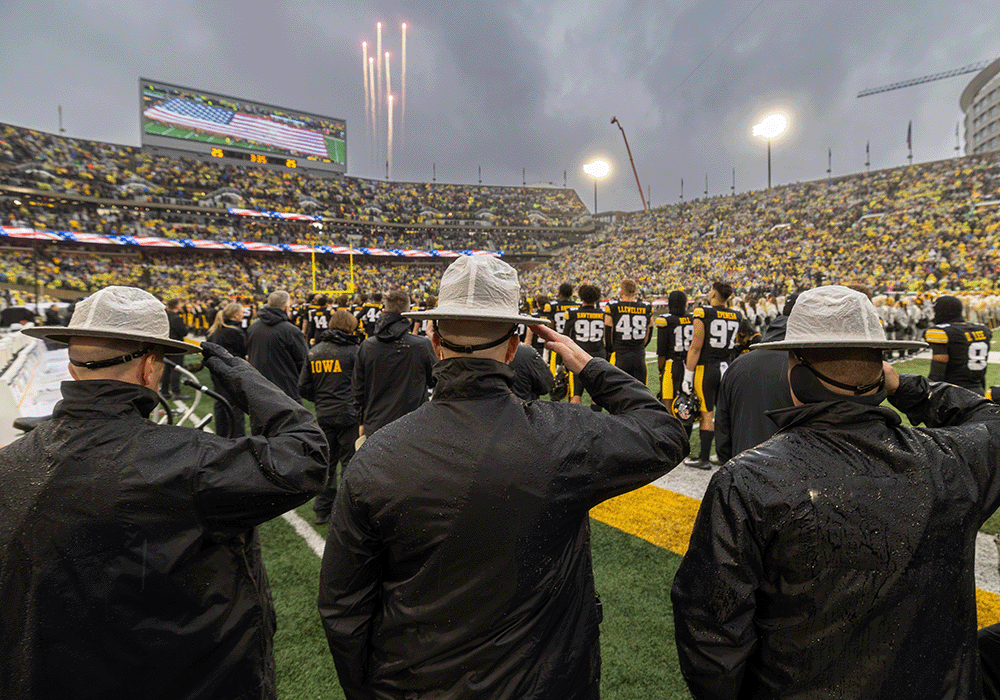
Up above on game day, an Iowa State Patrol airplane monitors activity in and around the stadium, while drones transmit video feeds back to the command center. Event operations staff address fan issues submitted via text and use digital signage to communicate parking lot closures or emergency messages. Attendees who violate a stadium policy and are uncooperative can land in one of the temporary holding cells for short-term detention until arrestees are transported to the Johnson County Jail to be booked. Most incidents involve alcohol offenses or disorderly conduct. After the game, the Iowa Department of Transportation helps optimize traffic flow through a program that in recent years leans more on AI to offer longer green lights for traffic moving away from the stadium.
Close Care
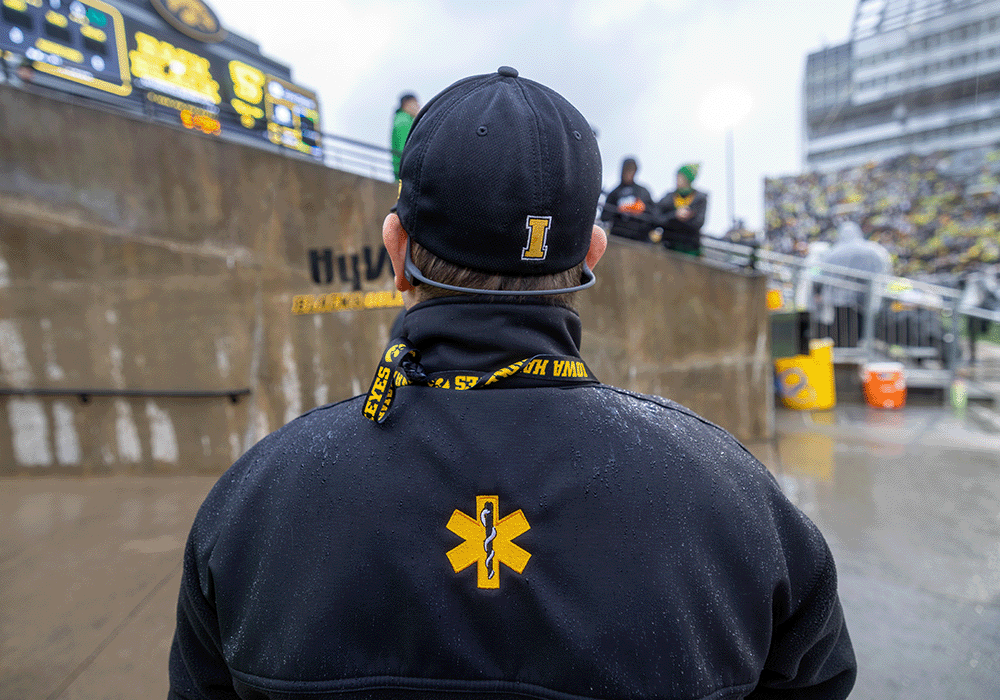 PHOTO: John Emigh
Kinnick Stadium’s medical team of approximately 40 physicians, nurses, paramedics, and technicians are ready to act at a moment’s notice on game day. Melvin Donaldson, the stadium’s medical director and a UI Health Care emergency department physician, oversees all emergency medical responses, which vary in number depending on weather conditions and kickoff time.
PHOTO: John Emigh
Kinnick Stadium’s medical team of approximately 40 physicians, nurses, paramedics, and technicians are ready to act at a moment’s notice on game day. Melvin Donaldson, the stadium’s medical director and a UI Health Care emergency department physician, oversees all emergency medical responses, which vary in number depending on weather conditions and kickoff time.
Kinnick Stadium’s proximity to UI Health Care Medical Center and Stead Family Children’s Hospital can make it challenging to maintain a perimeter and transport patients through traffic congestion to the hospital. However, those inside Kinnick are in one of the safest places they could be on a Saturday if they were to experience a severe medical issue like cardiac arrest. Highly trained first responders from the Iowa City Fire Department and Johnson County Ambulance Service are on scene, while a Level 1 trauma center is only minutes away. “We’ve saved a lot of lives,” says Visin. “[They] may not have had such good outcomes if they weren’t at an Iowa football game with our law enforcement, paramedics, and firefighters there to take care of these people and get them to critical care within minutes.”
Click to enlarge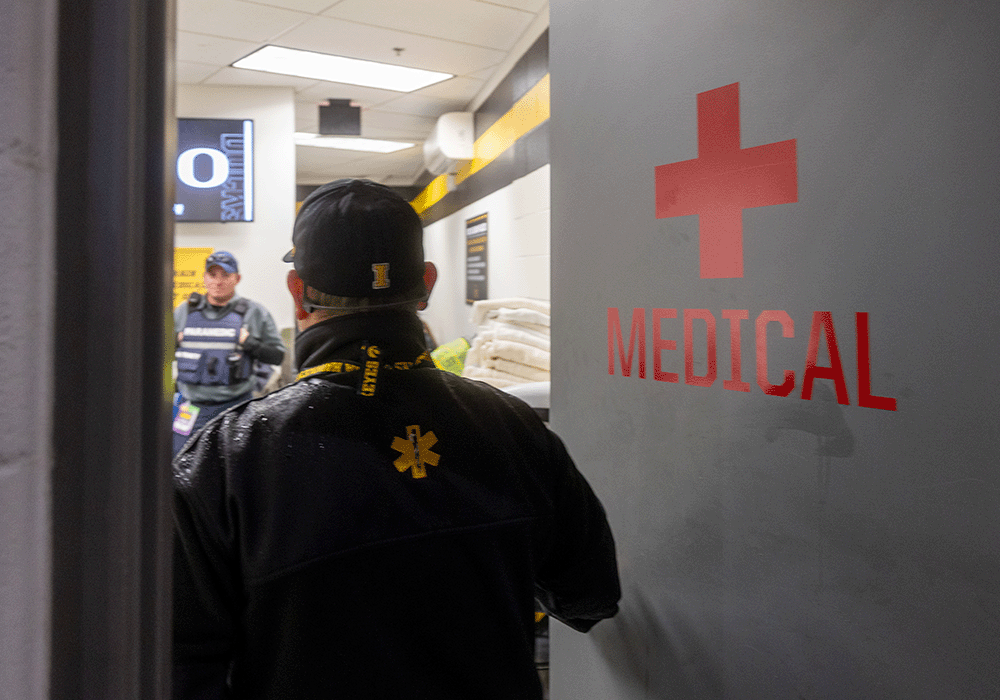
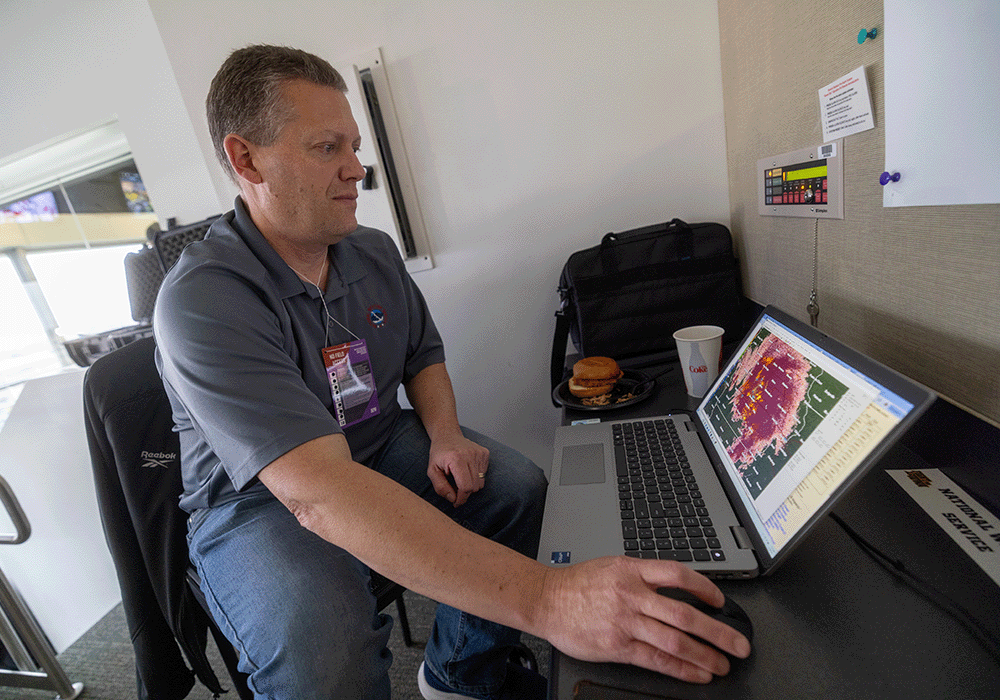
From first responders and parking attendant volunteers to national agencies like the FBI and the U.S. Department of Homeland Security, an extensive network of groups works together to support a safe environment at Kinnick Stadium. What may feel like a routine task of reuniting a lost child with their family or returning a lost wallet to its owner can have a drastic impact on a fan’s experience. Regardless of the game’s outcome, these essential personnel take pride in the role they play to ensure fans have a safe and fun Saturday.
“These are truly community and statewide events,” says Mark Bullock (20MBA, 21BLS), assistant vice president of UI Campus Safety, of the essential partnerships involved in game day. “We’ve never scored a touchdown, but we all contribute in some way by preparing the stadium and the environment so that people can come enjoy these opportunities.”
KINNICK GAMEDAY
What Hawkeye Fans Consume Most at Kinnick
Top-Selling Kinnick Stadium Concessions Items


Game day concessions sales averages


Kinnick Stadium concessions employees per game
