
Pulitzer Prize Winner Yiyun Li Headlines Iowa’s Literary Legends Talk
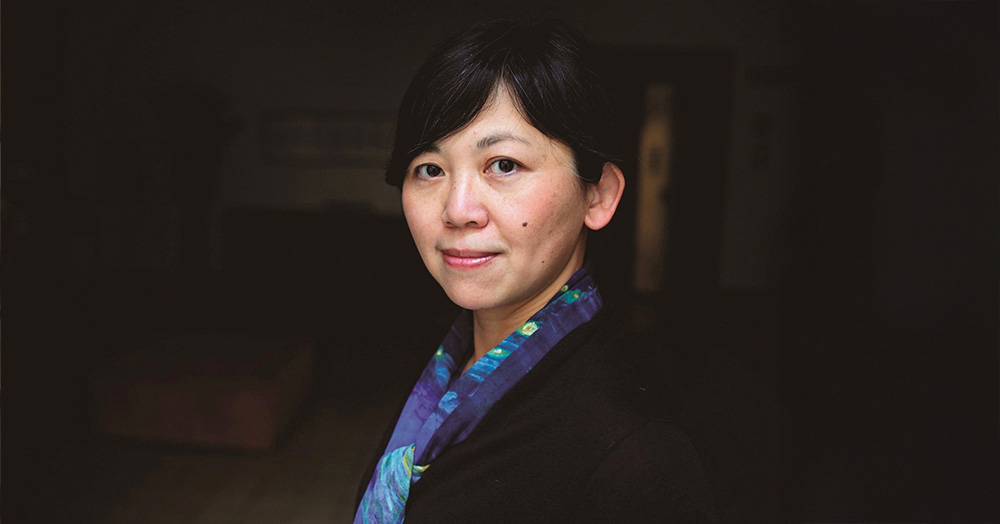 PHOTO: BASSO CANNARSA/AGENCE OPALE
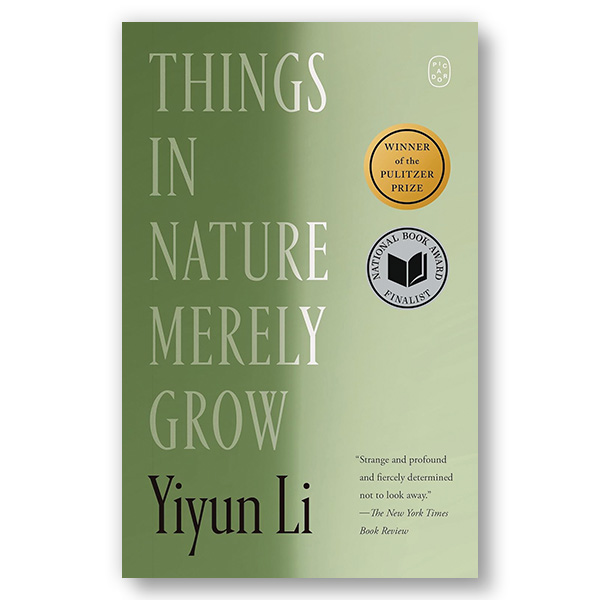
Iowa alumna and Princeton University professor Yiyun Li is the author of 12 books, including her recent memoir, Things in Nature Merely Grow.
PHOTO: BASSO CANNARSA/AGENCE OPALE
Iowa alumna and Princeton University professor Yiyun Li is the author of 12 books, including her recent memoir, Things in Nature Merely Grow.
The reporter’s call came while Yiyun Li (00MS, 05MFA) was attempting to soothe her geriatric dog during a drive to the vet. That’s how the Beijing-born writer learned she’d just won a 2026 Pulitzer Prize for her achingly spare memoir, Things in Nature Merely Grow, which chronicles the devastating aftermath of her sons’ suicides, six years apart.
This bright moment within the mundane mirrors one of her book’s main themes: that facts, language, and life persist, even in the face of unthinkable tragedy. Li, an award-winning novelist who is the Robert F. Goheen Professor in the Humanities at Princeton University, spoke about loss and literature in an interview with Iowa Magazine. She’ll return to campus Oct. 23 for the UI’s annual Literary Legends program, held in conjunction with the Iowa City Book Festival.
You left Beijing to study immunology at the University of Iowa before switching tracks and enrolling in the Nonfiction Writing Program and the Iowa Writers’ Workshop. What inspired that radical shift?
I loved all things science—and still do. I often read scientific news and papers with interest. However, I changed my career because I felt compelled to try something new, something different and challenging, that would have less of a clear path forward than if I had stayed in science.
How did your workshop experiences influence the writer you’ve become?
I greatly benefited from studying and talking with my mentor, James Alan McPherson (71MFA), and Marilynne Robinson (17LHD) has left an indelible mark on my reading and writing. Several visiting authors—Elizabeth McCracken (90MFA), Edward Carey, Jim Crace, Stuart Dybek (73MFA), and Francine Prose—also shaped me as an author.
You began writing in English after growing up speaking Chinese. How has this shaped your voice?
I think through everything carefully. A word must be scrutinized before being put down on the page. I value clarity and precision, and writing in a second language makes it both easier and harder to achieve this.
Why did you decide to write a memoir about your sons, Vincent and James? And how did you find a way to begin the work?
I consider myself mainly a fiction writer. But life happens, and sometimes life makes fiction look tame. I write nonfiction when things happen to me that make it necessary to do so. And the way to begin writing about my life is always to start with the facts.
How did you choose this book’s title? What did you want it to reveal about your central themes?
I did not have a title for the book while writing it; I kept referring to it as “the book for James.” That summer, I also did a lot of gardening and posted some of my garden pictures on a private Instagram account, always under the caption, “Things in nature merely grow.” At the end of the book, that felt like a natural title.
Both readers and reviewers have remarked on the extraordinary precision and restraint of your prose. What role did language play in helping you make sense of your sons’ suicides?
To quote a Wallace Stevens poem, my goal for this book, or any of my writing, is “to speak humanly from the height or from the depth/Of human things, that is the acutest speech.”
In other interviews, you’ve referenced the framework of “radical acceptance”—which you credit to psychologist Marsha Linehan—as a way in which to live with your sons’ deaths. What does the concept mean to you?
For me, it means to always start with the facts and not to be entangled by questions of “what if?” As I wrote in my book, “what if?” belongs in fiction, and “what now?” belongs to life. Radical acceptance means to be in the “what now?”
What literary ideas continue to engage you?
I write out of curiosity and bafflement. I remain curious about many things, and I feel baffled by many things. Most recently, I have been working on a trilogy that’s set in the late 18th and early 19th centuries, and I think I shall be spending my life with those characters for a while. The first work in the trilogy, Music Against the Night, will be published in October.
LITERARY LEGENDS
Featuring Pulitzer Prize winner Yiyun Li
7:30 p.m. on Friday, Oct. 23
Levitt Center for University Advancement
Come for a special evening with acclaimed author Yiyun Li, one of Time Magazine’s 100 Most Influential People of 2026, held in conjunction with the Iowa City Book Festival.
LITERARY LEGENDS
Featuring Pulitzer Prize winner Yiyun Li
7:30 p.m. on Friday, Oct. 23
Levitt Center for University Advancement
Come for a special evening with acclaimed author Yiyun Li, one of Time Magazine’s 100 Most Influential People of 2026, held in conjunction with the Iowa City Book Festival.