
How Three Iowa Scientists Find Inspiration in the Natural World
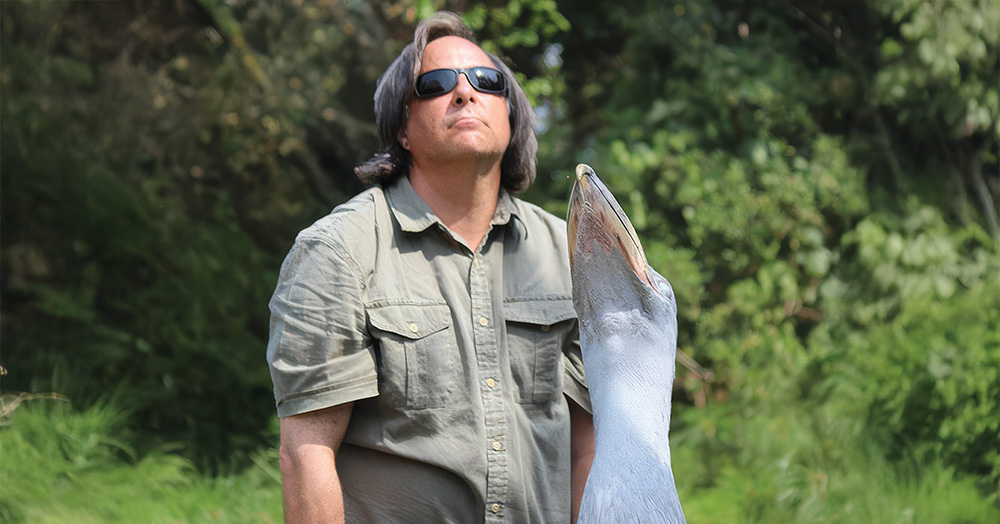 PHOTO COURTESY CHRISTOPHER BROCHU
At the Uganda Wildlife Conservation Education Centre in 2016, UI paleontologist Christopher Brochu (above) saw the rare shoebill, a large bird that inhabits the swamps and wetlands of East Africa.
PHOTO COURTESY CHRISTOPHER BROCHU
At the Uganda Wildlife Conservation Education Centre in 2016, UI paleontologist Christopher Brochu (above) saw the rare shoebill, a large bird that inhabits the swamps and wetlands of East Africa.
Walking along the Iowa River at the heart of campus, pedestrians can observe bald eagles circling, Canadian geese waddling, and songbirds perched in the trees. For students, faculty, and staff at the University of Iowa, these encounters might inspire a deeper curiosity about the natural world. Here are three stories of UI researchers in Earth and environmental science, psychological and brain sciences, and mechanical engineering who study birds in the Hawkeye State.
Eagle-Eyed Scientist
Most birders have a “trigger bird”—the sighting that sparked their interest in birdwatching.
Christopher Brochu (89BS) first became captivated by a blue-gray and white bird as a first-year UI geology student sitting on his grandparents’ covered porch during an Iowa City blizzard. A field guide helped him identify it as a white-breasted nuthatch. “The more I flipped the field guide, the more I noticed other birds—like the red-breasted nuthatch, which is closely related but distinct—and that got me interested in bird diversity,” says Brochu, who is now a professor in the UI School of Earth, Environment, and Sustainability.
“I went and bought my own field guide, and the rest is history.”
Today, Brochu is a renowned paleontologist who studies the evolutionary history of crocodilians, examining fossils from around the world to understand how various species differ and change over time. Birding, he says, makes him sharper at observing the subtle distinctions between specimens. “Studying fossils makes me a better birder,” says Brochu, “but working on birds makes me a better paleontologist.”
Birding also has shaped his teaching. In UI courses such as How Birds Work and Age of Dinosaurs, Brochu teaches the origin of birds, which are classified in taxonomy as theropod dinosaurs. Evolved from small, bipedal theropods from the Mesozoic era, they share traits such as feathers, hollow bones, and nest building and brooding. “Once you evolve from the ancestor of a group, you’re a part of that group, and you never leave it,” says Brochu. “Birds are dinosaurs for the same reason that you and I are mammals or primates.”
Brochu, who has an extinct Miocene crocodile genus named in his honor, recently identified a previously unknown species of crocodile in Ethiopia that lived more than 3 million years ago. While on such research expeditions, Brochu sets aside his free time for birdwatching with local guides. In 2016, he encountered his first shoebill, a prehistoric-looking bird that was eating a lungfish in Uganda. “That was one I’ll never forget,” he says.
The beauty of birdwatching, Brochu says, is that it can be done anywhere, from a warbler walk in Hickory Hill Park with the Iowa City Bird Club to a visit via subway to the Jamaica Bay National Wildlife Refuge in New York. “It keeps you in tune with the seasons, gets you outside. You get to meet some incredible people. It’s an intellectually stimulating exercise,” he says. “There are as many reasons to bird as there are birds, and you’re always going to have a good time doing it.”
—Shelbi Thomas
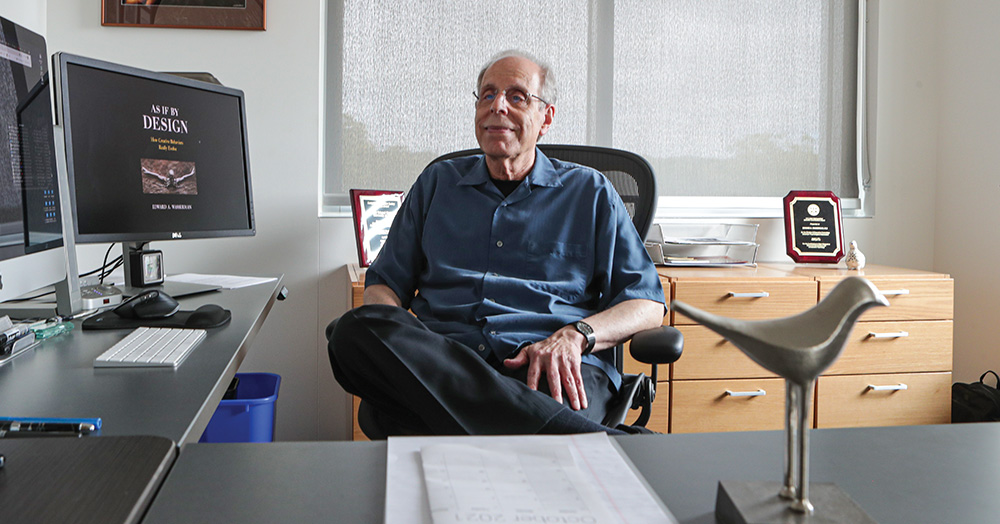 PHOTO: JOHN EMIGH
Stuit Professor of Experimental Psychology Ed Wasserman researches and compares learning, memory, and cognition in animals.
PHOTO: JOHN EMIGH
Stuit Professor of Experimental Psychology Ed Wasserman researches and compares learning, memory, and cognition in animals.
Pecking Order
If you were rewarded for following a particular pattern of behavior, wouldn’t you keep doing it? The answer turns out to be more nuanced than you might think.
In a new study published in the Journal of Experimental Psychology: Animal Learning and Cognition, UI researchers report that pigeons rewarded with food after pecking five buttons in any order never gravitate toward a single pattern but instead consistently elect to try different sequences.
Ed Wasserman, professor in the Department of Psychological and Brain Sciences, calls the pigeons’ pattern of behavior “responding at the edge of chaos.”
“What we learned is there’s something that keeps the birds from becoming fully machinelike in their responses,” says Wasserman, the study’s corresponding author. “Maybe it’s in their best interest to keep some variability in their behavior. You don’t want to be too locked in, because things happen, and the world could change.”
The study also extends the notion of the edge of chaos beyond evolutionary biology, where flexibility to a changing environment can be beneficial to a species’ survival.
“Might other, more intricate and innovative behaviors like playing an instrument, composing music, and creating visual art involve similarly adaptive variation?” says Odysseus Orr (23BA, 23BS, 25MA), study coauthor and third-year graduate student in the Department of Psychological and Brain Sciences. “Only time will tell, but the pigeons provide a convenient gateway for answering those questions under highly controlled circumstances.”
Wasserman, Orr, and study coauthor Sophia Li devised an experiment to test the Law of Effect. This law posits that animals, including humans, will repeat a response—and winnow other options—when it produces a rewarding outcome. The researchers enlisted six pigeons to peck five buttons in any order they chose, yielding a set of 120 possible sequences. The birds were given no training; in fact, any of the 120 total possible five-button sequences generated a treat.
The researchers found that each of the pigeons performed all 120 sequences. The birds also increasingly performed some sequences at the expense of others, consistent with the century-old Law of Effect.
But the researchers were surprised to discover that the pigeons never fully committed to any of their most-favored sequences. More surprising, the pigeons’ most preferred five-button sequences rose and fell throughout the eight months and 30,000 times they performed the task.
“Such dramatic behavioral instability is most definitely not consistent with the Law of Effect,” says Wasserman, who has studied pigeon cognition and behavior for more than five decades. “The pigeons maintain this exploratory tendency and keep trying multiple sequences. They do not abide by the familiar maxim: ‘If it ain’t broke, don’t fix it.’”
The results generally followed earlier behavioral-reward studies with other animals—including mice, rats, cats, and guinea pigs—that found they reduced their range of options when finding one that consistently produced a reward, the authors write. But while the variability in the pigeons’ response sequences decreased, the Iowa team’s study showed clearly that the pigeons also repeatedly switched among their favorite sequences and never ceased considering even seemingly less preferred sequences.
—Richard C. Lewis
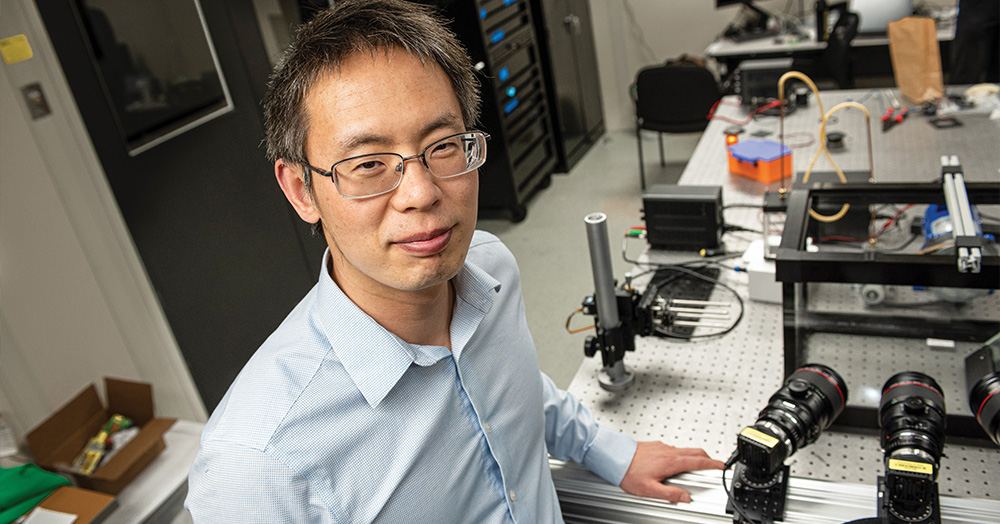 PHOTO: ANETA GOSKA
With Mother Nature as his muse, assistant professor Cong Wang conducts fundamental fluid dynamics research at the UI College of Engineering.
PHOTO: ANETA GOSKA
With Mother Nature as his muse, assistant professor Cong Wang conducts fundamental fluid dynamics research at the UI College of Engineering.
Inspired by Nature
Cong Wang enjoys taking his kids outside to experience nature as he did as a boy.
Growing up in China, he was fascinated by insects, birds, and fish. “Even now as an engineering scientist … I still think that’s a great resource for my research work,” says Wang, a UI assistant professor of mechanical engineering and IIHR assistant faculty research engineer. “Birds know how to control their feathers, their wings, and they can manipulate the [air] flow.” Even compared to state-of-the-art technology, Wang says, nature often does it better.
Wang’s excited by the emerging field of bio-inspired engineering—essentially, learning from the natural world. “Mother Nature has already developed very dedicated flow control devices,” he says. “The fish, the birds—they know how to deal with very complex flow motion.”
He adds, “We can learn from the natural world … and based on that knowledge, we can design some new devices and systems, all to achieve better performance.”
Wang’s work focuses on fluid dynamics—experimental work and theoretical analysis of turbulent flow, which can cause a huge energy loss for ships and other vehicles. He hopes to develop devices that will allow researchers to achieve better turbulence control.
Wang knows it will take time to solve such fundamental problems. “I think doing research is maybe 95% failure. Most of the time it doesn’t work,” he says. But when it does, that’s the payback.
As Wang says, “That kind of aha moment—it’s very rewarding.”
—Jackie Hartling Stolze