
Iowa Neurosurgeons Pioneer Less Invasive Surgery for Children with Epilepsy
When newborn Javen Veenstra was airlifted to University of Iowa Health Care in Iowa City two years ago, his parents were desperate for answers.
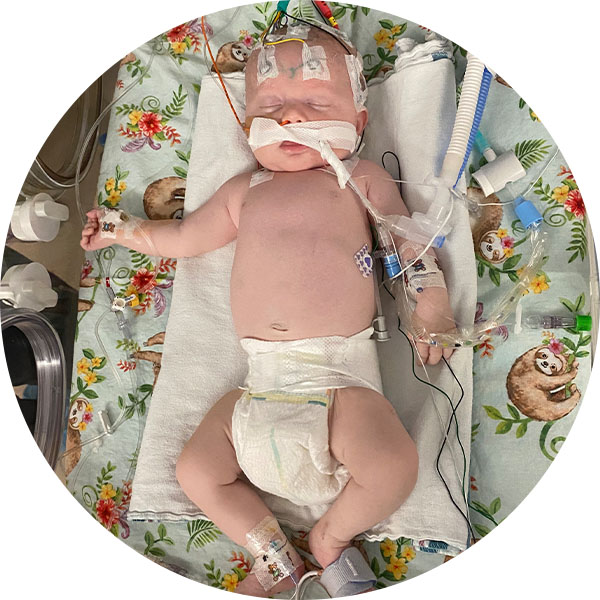 PHOTO COURTESY VEENSTRA FAMILY
Javen Veenstra, who today is nearing his third birthday, underwent a series of novel surgeries at UI Health Care Stead Family Children's Hospital to treat a rare condition that caused multiple seizures every day.
Just days earlier, Alex and Kirsten Veenstra were thrilled to welcome Javen home. He was doing what babies do best: sleeping, eating, looking cute, and keeping his mom and dad awake at all hours of the night.
At first, the signs were subtle. Javen’s eyes repeatedly drifted to the right. His tiny body twitched. Newborns often have unusual moments and reflexes, but the family’s instincts told them something wasn’t normal.
It looked like seizure activity.
Within hours, the Veenstras found themselves on a frightening journey. A local emergency room visit led to brain scans and conversations filled with unfamiliar medical terminology. As doctors searched for answers, the family’s anxiety continued to grow.
“There wasn’t a lot of hope at first,” says Kirsten. “We weren’t sure if Javen was going to make it. We weren’t sure what his future would look like.”
Answers in Iowa City
Long before Javen was born, the Veenstras—who now live in Oskaloosa, Iowa—had carefully chosen their baby’ name.
“Javen means youth and vitality,” says Kirsten. “We had a friend with that name, and he was a really cool guy. We just loved it.”
The name reflected everything they hoped for their son and the future that lay ahead of him.
Following Javen’s airlift, the Veenstras packed their bags expecting to stay a week in Iowa City. Instead, they would spend nearly two months at UI Health Care Stead Family Children’s Hospital.
Tests there revealed the cause of Javen’s seizures as hemimegalencephaly, an extremely rare condition where one half of the brain is overgrown, leading to multiple seizures every day.
The only treatment is to shut down the malfunctioning half of the brain, a process that typically involves open brain surgery to remove the brain tissue causing the seizures and completely disconnect the unhealthy hemisphere. This preserves and protects the healthy side of the brain and allows it to adapt.
“I didn’t even know you could live with half a brain,” says Kirsten.
Yet even that surgery wasn’t an immediate option. At just 6 pounds, Javen was too small for the traditional procedure. But waiting carried its own risks. Javen’s seizures were occurring hundreds of times a day, threatening to damage the healthy hemisphere of his developing brain.
Fortunately, a team at UI Health Care had been working on another possibility.
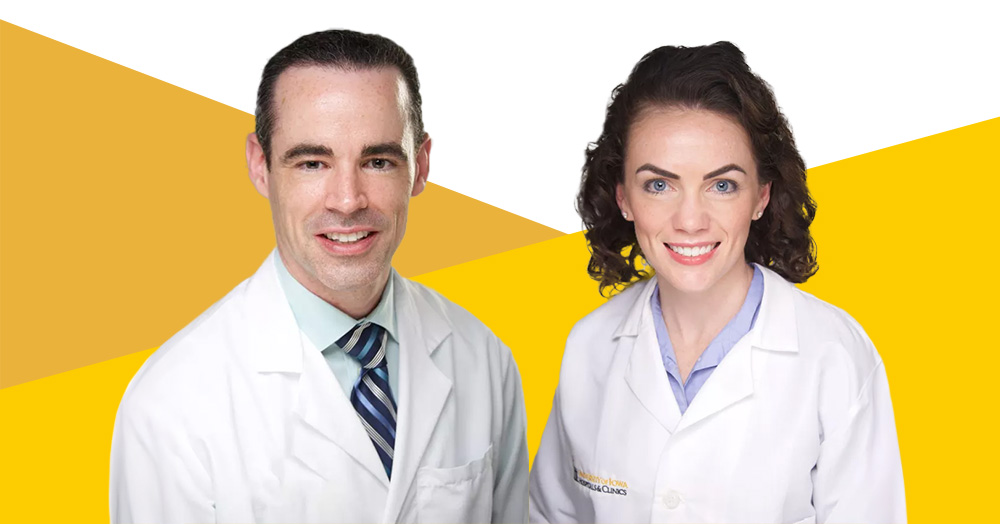 PHOTO: UI HEALTH CARE
UI Health Care neurosurgeons Brian and Katie Dlouhy
A Different Approach
Many medical breakthroughs begin in laboratories. The idea that would ultimately help Javen began around a family dinner table.
Husband-and-wife neurosurgeons Brian Dlouhy (13R, 14F) and Kathleen “Katie” Dlouhy share a passion for tackling some of medicine’s most complex neurological disorders. Brian works with children, performing delicate brain surgery to treat epilepsy. Katie is an endovascular surgeon who treats brain problems by accessing the brain vascular system through blood vessels to divert and control blood flow.
As an epilepsy surgeon, Brian had performed traditional hemispherotomy procedures for years. While highly effective, the surgery is a major undertaking for any patient, and he began wondering if there might be a less invasive way to achieve the same result.
Together, they studied imaging from previous patients and explored whether a procedure commonly used for other neurological conditions could be adapted. Drawing on their expertise from two different specialties, they envisioned a way to disconnect a diseased hemisphere without open brain surgery.
For Katie, the concept was promising, but it required careful consideration.
“The outcomes are so good with traditional surgery that we wanted any patient treated endovascularly to have an equally good outcome,” she says. “The goal is seizure freedom, and we needed confidence that we could accomplish that.”
The new approach relied on tiny catheters inserted through the groin and navigated through the body’s vascular system to the brain. Rather than removing brain tissue through open surgery as Brian would do, Katie would use the catheters to gradually cut off blood flow to the diseased hemisphere through a series of precisely targeted embolizations, achieving the same end goal with a far less invasive procedure.
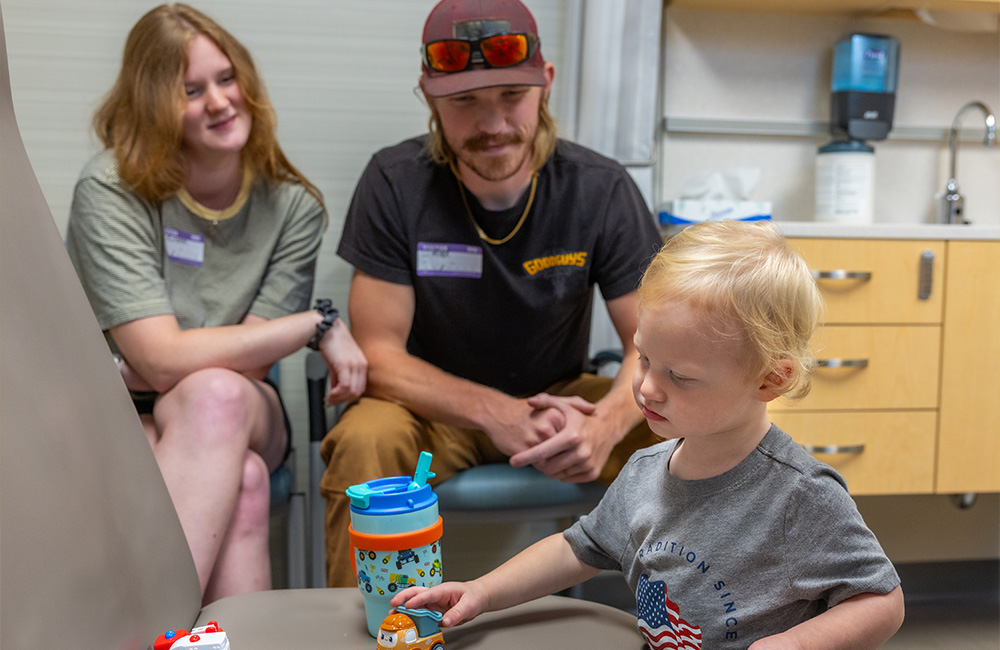 PHOTO: KYLE SLEICHTER/UI HEALTH CARE
Javen Veenstra with his parents, Kirsten and Alex
Choosing Hope
When the Dlouhys presented Alex and Kirsten with both treatment options—the traditional open surgery and the novel endovascular approach—the Veenstras felt something they hadn’t since Javen’s diagnosis: hope.
“They laid everything out for us really well,” says Kirsten. “There were scary parts to both options, but it was encouraging to know there was something we could do.”
Patient safety was central to the Dlouhys, with multiple layers of safeguards built into every step. Before Javen was even considered for the endovascular procedure, his situation was reviewed by a larger team of pediatric epileptologists, pediatric and vascular neurosurgeons, and pediatric neuroradiologists.
Brittany Sprigg was the attending pediatric epileptologist in the intensive care unit at Stead Family Children’s Hospital when she met the Veenstras.
“In general, with all kinds of epilepsy surgery, earlier is better,” says Sprigg. “The more time you give the brain to reconfigure, grow, and not have seizures, the better for development, and both of Javen’s parents wanted what was best for him.”
Despite careful planning and confidence in Javen’s care team, nothing could prepare Alex and Kirsten for watching their young son head into an operating room for the pioneering endovascular approach, connected to breathing tubes, IV lines, and monitoring equipment.
“You try to walk around. You try to eat a little. But you’re not hungry. You can’t stop thinking about what could go wrong,” says Alex.
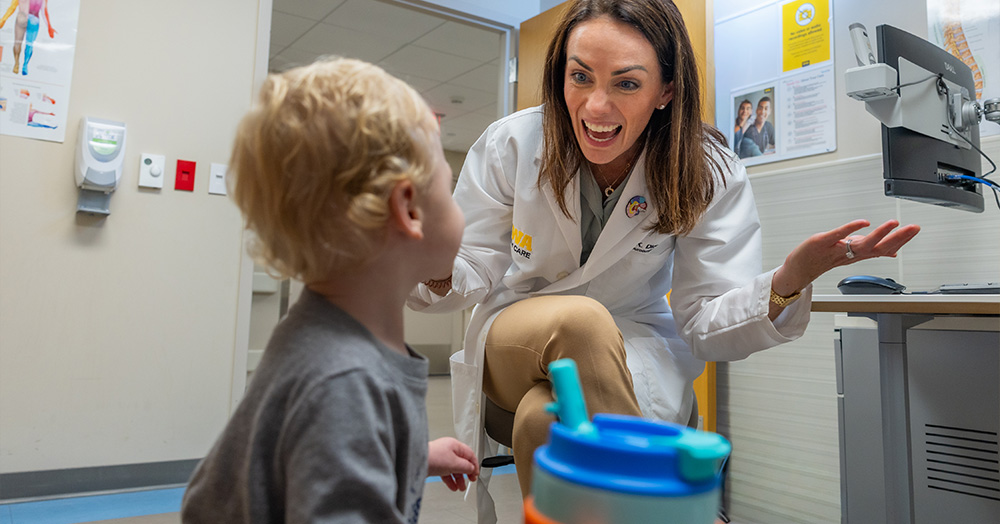 PHOTO: KYLE SLEICHTER/UI HEALTH CARE
UI Health Care neurosurgeon Katie Dlouhy meets with Javen during a follow-up appointment.
Progress in Stages
The procedure demanded extraordinary precision. Using tiny catheters threaded through tiny blood vessels in the brain, Katie gradually cut off blood flow to the diseased part of Javen’s brain. Activity in the brain was closely monitored during the procedure to confirm the treatment was achieving its intended effect.
“One of the biggest advantages is that the procedure is completely incisionless,” says Katie. “There is no large opening in the skull, no scalp incision, and no bone removal. That typically means there are far fewer complications than what we worry about with open surgery.”
Still, rather than attempting everything at once, the care team proceeded cautiously.
“We knew this would likely require multiple procedures,” says Brian. “We wanted to treat one area, give it time, and monitor for swelling before proceeding.”
One procedure became two. Two became three. In between, Javen remained in the intensive care unit while physicians closely monitored his recovery. To the relief of everyone involved, the seizures began to subside.
“Getting the seizures under control was huge,” says Kirsten. “That changed everything.”
After the third procedure, Javen was ready to leave Iowa City.
The seizures that had once threatened his life were gone. While he remained on medication as a precaution, the family felt what had seemed impossible months earlier: optimism.
“We don't expect seizures to come back once the affected hemisphere is taken care of,” says Sprigg. “What’s remarkable is how adaptable a child's brain can be. The healthy side is able to take over important functions, allowing patients to overcome obstacles and continue developing.”
And Javen has continued to do just that.
The little boy whose parents once feared he might not even survive is now achieving developmental milestones, discovering his personality and love for cats, and proving every day what’s possible with the help of his family and care team.
A Better Path Forward
Since treating Javen, Katie has expanded the approach to other children with devastating forms of epilepsy, including patients who have experienced perinatal stroke and other severe disorders affecting one side of the brain.
The outcomes have reinforced what the Dlouhys first hoped around a family dinner table years ago: a better path is possible for children facing catastrophic epilepsy.
For families like the Veenstras, that means everything.
“It’s crazy how far modern medicine has come,” says Kirsten. “Javen has such a joy for life. He makes everyone laugh. He’s doing it all with half a brain, and it’s just amazing.”
Helping Families When They Need It Most
The compassion and innovation that shaped neuroscience at UI Health Care can be traced through generations of Iowa faculty. Among the most influential was Arnold H. Menezes (74R), a pioneering neurosurgeon and mentor to Brian Dlouhy (13R, 14F). His legacy continues through the Dr. Arnold H. Menezes and Dr. Meenal A. Menezes Patient and Family Assistance Fund, which helps patients and families manage nonmedical expenses such as lodging, transportation, meals, and other essential costs associated with treatment.