Ferentz Family's Neonatal Research Gift Continues to Give Hope to Preemies
 PHOTO: SETH DIEHL
Kirk and Mary Ferentz are pictured at their home in Iowa City.
PHOTO: SETH DIEHL
Kirk and Mary Ferentz are pictured at their home in Iowa City.
For the families of babies born prematurely, weeks—or even days—can mean the difference between heartbreak and hope.
Mary Ferentz still remembers the phone call in August 2014. Football season would soon arrive in Iowa City. A few days earlier, Kirk Ferentz had opened preseason practice for his 16th season as Iowa’s head coach.
Life had other plans.
Their daughter-in-law went into labor far earlier than expected. She was rushed to University of Iowa Health Care, which was building a reputation for its care of infants born on the edge of viability.
Kirk and Mary’s grandchild, Savvy Elizabeth Ferentz, was born days later at just 21 weeks and 5 days gestation.
A decade later and things might have been different, but in 2014, 22 weeks was widely considered the earliest point at which intensive care could offer the possible hope of survival.
Mary asked one question: “Is she alive?”
“We had just sort of accepted the inevitable, you know?” says Mary. “At 21 weeks, that was unheard of.”
Savvy was alive. When she and Kirk arrived at the hospital, they were greeted with warmth. “Grandma, Grandpa, come on in.”
More than a decade later, the moment still stands out. Mary remembers the tubes. The monitors. A baby so small she could fit inside the palms of adult hands.
Savvy fought for two days before she died.
The days that followed brought unbearable grief. But along with the pain came something unexpected. People wanted to help. Flowers arrived. Notes appeared. Checks and donations showed up from friends, former players, opposing coaches, and total strangers. The gifts eventually totaled some $15,000. The grieving parents asked Mary to help determine what should be done with it all.
Mary knew UI Health Care’s neonatal team had been achieving remarkable outcomes with premature babies, but that researchers needed support to advance their work. “I remember thinking, ‘Why don’t we provide that?’” says Mary.
The donations became the foundation of the Savvy Ferentz Program in Neonatal Research. Kirk and Mary later expanded the effort with a $1 million gift, transforming a memorial fund into a permanent source of research support.
The funding became a catalyst for junior researchers to explore additional avenues of healing, while supporting the establishment of new programs such as neonatal hemodynamics. UI Health Care’s neonatal intensive care unit became one of the first in the country to monitor the cardiovascular health of its preterm patients using this advanced form of imaging. The approach cut the combined risk of death or severe brain bleeding by nearly half for babies born before 27 weeks’ gestation. The additional funding also led to a new software platform that allows clinicians to monitor real-time medical data remotely to improve patient outcomes.
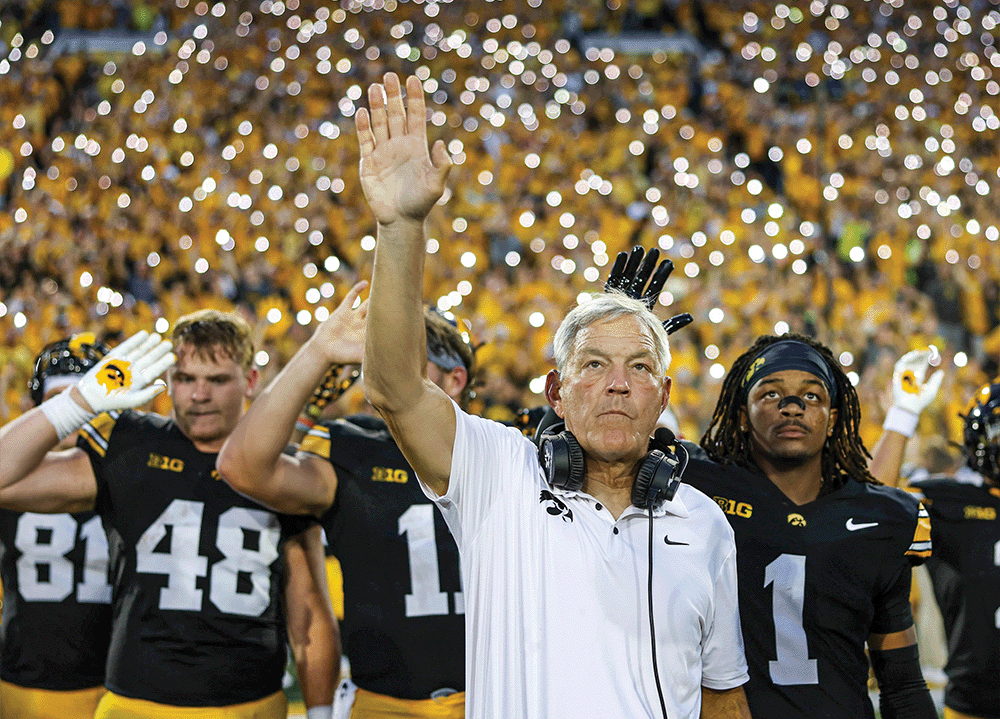 PHOTO: BRIAN RAY/HAWKEYESPORTS.COM
Coach Kirk Ferentz participates in the Iowa Wave to pediatric patients at UI Health Care Stead Family Children’s Hospital.
PHOTO: BRIAN RAY/HAWKEYESPORTS.COM
Coach Kirk Ferentz participates in the Iowa Wave to pediatric patients at UI Health Care Stead Family Children’s Hospital.
And then came July 5, 2024, and a baby named Nash Keen. On that day, a mother from Ankeny, Iowa, gave birth at UI Health Care to a boy at 21 weeks and 0 days gestation. Nash weighed just 10 ounces. For the baby’s first 21 days of life, his parents, Mollie and Randall Keen, couldn’t hold him. But thanks to medical research breakthroughs—funded by thousands of other families in honor and memory of children loved and some lost—in January 2025 he was able to go home.
On Nash’s first birthday, the Guinness Book of World Records recognized him as the most premature baby to survive.
Five days younger than Savvy.
Against odds once thought impossible, Nash thrived. Today, now 2, he looks less like a medical miracle and more like what doctors hoped he would become: a happy little boy with bright eyes and an infectious smile.
“My ultimate goal for Nash is that by the time he goes to kindergarten, no one will know that he was born so early,” says UI Health Care neonatologist Amy Stanford (14MD, 17R, 20F, 21F).
For the Ferentzes, stories like Nash’s don’t erase what their family endured. Asked what comes to mind when they think of Savvy today, Kirk lowers his head. He talks about the nurses, physicians, and researchers who devoted their careers to helping children many hospitals once considered too premature to save.
Between Savvy and Nash, the line moved.
“History absolutely guarantees results,” says Mary. “But they’re never fast enough or immediate enough. When we got involved, we had no idea where [neonatal research and care] was going. But it’s a wonderful thing.”
How to Help
Give to the Savvy Ferentz Program in Neonatal Research, which supports and develops clinical and translational research focused on newborn health at the Carver College of Medicine.
GIVE NOW